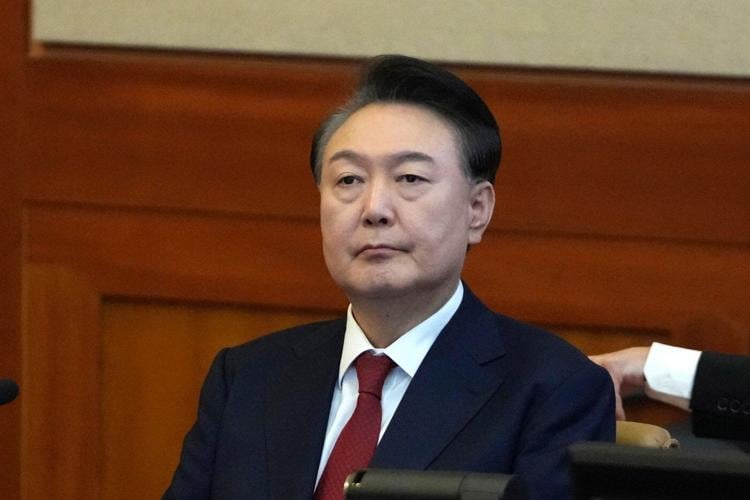
FILE - South Korea's impeached President Yoon Suk Yeol attends a hearing of his impeachment trial at the Constitutional Court in Seoul, South Korea, Feb. 11, 2025. (AP Photo/Lee Jin-man, Pool, File)
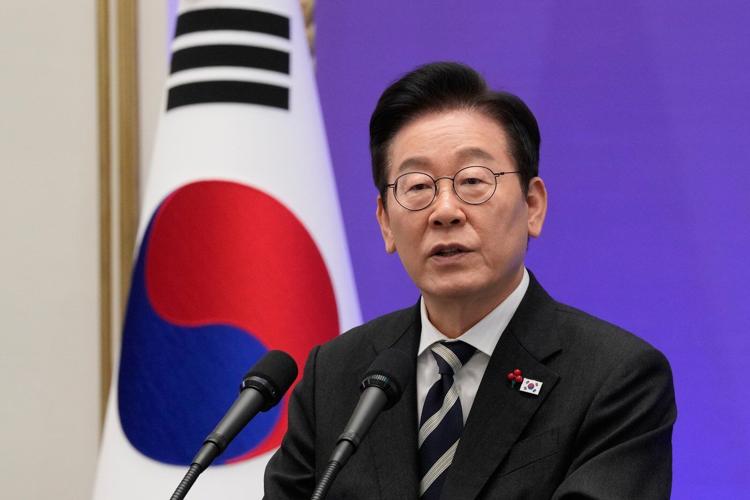
FILE - South Korean President Lee Jae Myung speaks during a news conference to mark the first anniversary of the Dec. 3 martial law crisis at the Blue House in Seoul, South Korea, Dec. 3, 2025. (AP Photo/Ahn Young-joon, File)
FILE - South Korea's impeached President Yoon Suk Yeol attends a hearing of his impeachment trial at the Constitutional Court in Seoul, South Korea, Feb. 11, 2025. (AP Photo/Lee Jin-man, Pool, File)
JM
FILE - South Korean President Lee Jae Myung speaks during a news conference to mark the first anniversary of the Dec. 3 martial law crisis at the Blue House in Seoul, South Korea, Dec. 3, 2025. (AP Photo/Ahn Young-joon, File)
SEOUL, South Korea (AP) — South Korea’s legislature on Tuesday passed a bill mandating specialized panels in Seoul’s district and high courts for cases involving rebellion, treason and foreign subversion after complaints about the pace of the rebellion trial of jailed former President Yoon Suk Yeol.
But the bill, which is likely to be signed into law by President , would fall short of the effect the Democratic Party initially sought from the liberal-led legislature. Lawmakers altered the wording to ensure the measure would not apply to ongoing trials. Critics have said the original draft risked infringing on judicial independence.
The law would require the Seoul Central District Court and the Seoul High Court to establish at least two specialized panels for cases involving rebellion, treason and foreign subversion. Each panel must consist of a three-judge bench selected by the judges’ council at each court.
The bill passed the legislature 175–2 with two abstentions after many conservatives boycotted the vote.
The vote was delayed after Jang Dong-hyuk, the leader of the conservative People Power Party, staged a 24-hour filibuster, arguing that the bill remained unconstitutional even after repeated revisions and accusing Democrats of pressuring courts to create benches they favor. Following Tuesday’s vote, PPP leaders called on Lee to veto the bill.
The law would go into effect immediately after Lee signs the bill, but will not apply to Yoon’s ongoing rebellion trial, which is expected to reach a verdict in early 2026. If Yoon’s case reaches the high court, it would be handled by the specialized panels.
Yoon was a staunch conservative who declared martial law in December 2024 to suppress what he called the “anti-state� liberals obstructing his agenda. He was removed from office in April and re-arrested in July over his botched power grab that lasted only hours. He faces a slew of serious charges including , which is punishable by life in prison or the death penalty.
The Democratic Party has repeatedly criticized a judge at the Seoul Central District Court who is handling Yoon’s rebellion case, claiming he has delayed proceedings by spacing out hearings and arguing that courts should reconsider the longstanding practice of randomly assigning judges in cases of exceptional importance such as rebellion.
The judge, , initially drew the ire of liberals in March by approving Yoon’s release from prison following his first arrest, allowing him to stand trial without detention until his rearrest in July.
The liberals’ complaints grew after other judges rejected investigators’ requests for arrest warrants on some key figures close to Yoon including former Prime Minister and senior conservative lawmaker . Han and Choo were accused, respectively, of aiding Yoon’s declaration of martial law and obstructing lawmakers from participating in a vote to lift the measure.