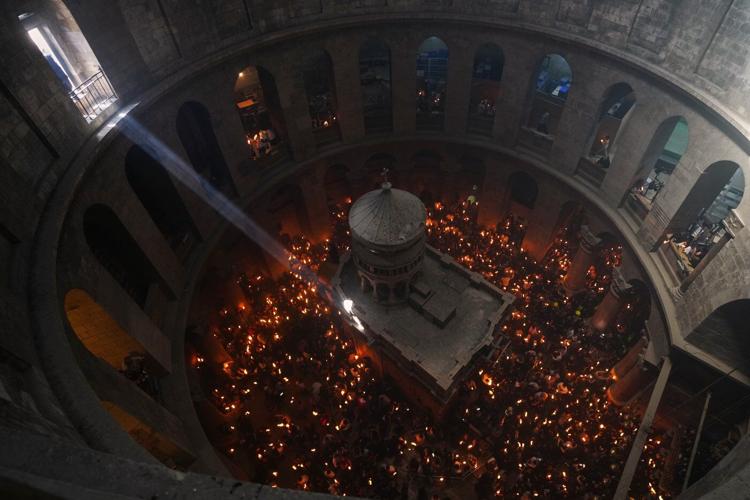
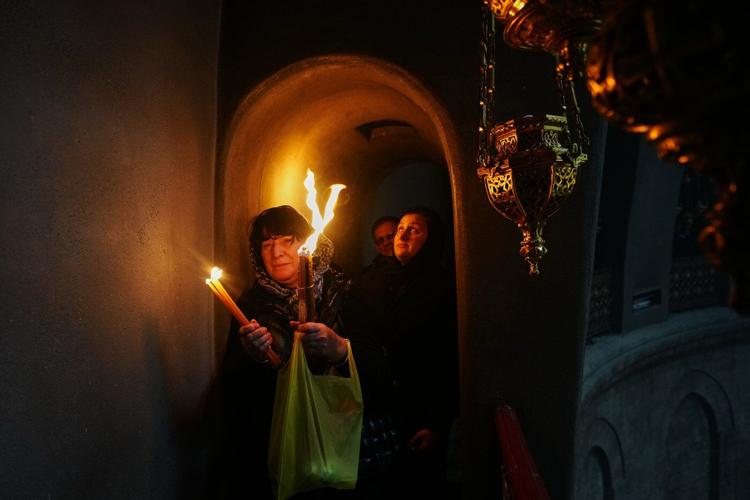
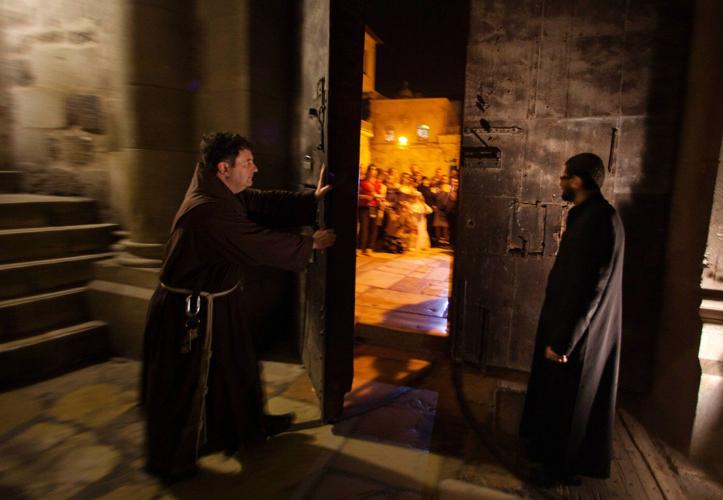
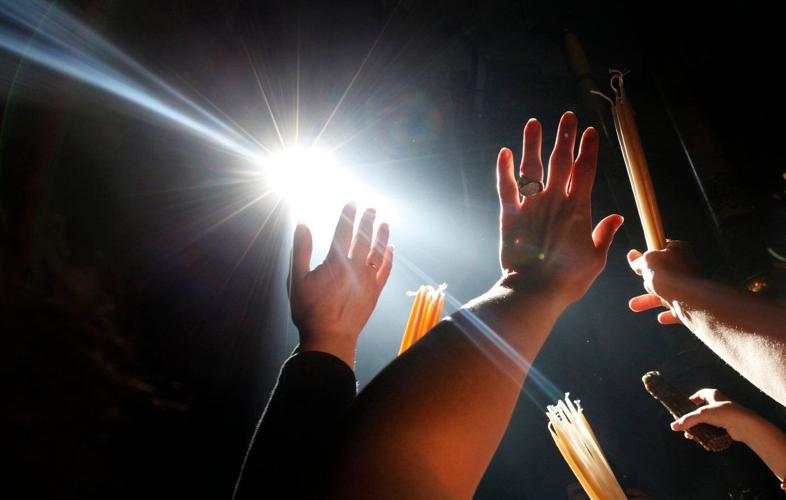
JERUSALEM (AP) — The enormous doors were pushed shut, the clanking bolts secured from the outside and several clergy, pilgrims and one journalist — me — were locked for the night inside one of Christianity's holiest sites in Jerusalem.
The was built over the spots where Christians believe Jesus was crucified, buried and rose from the dead.
Through many centuries, as Muslim rulers governed this region and changing politics affected the influence of religious powers, an arrangement evolved as unique as the church's jumbled architecture. Today, the Armenian Apostolic, Catholic and Greek Orthodox churches .
I watched through a tiny door slot as a representative from a Muslim family — they’ve been entrusted with the basilica’s keys since the 13th century — climbed a small wooden ladder to reach the upper bolt. Then he passed the ladder back through that same opening, which a Greek Orthodox priest locked shut too. Another wished us “Good night!� in English before hurrying away.
Most nights, from 9 p.m. to dawn, when the doors are reopened with the same ceremony, about a dozen priests, a smattering of registered pilgrims and a few cats have the sprawling, dark basilica to themselves.
While the priests and a few nuns quickly went about their rest or chores, it took us visitors a few quiet, contemplative moments to even decide where to start wandering in the venerated, labyrinthine space.
A unique prayer experience in Jerusalem's holiest church
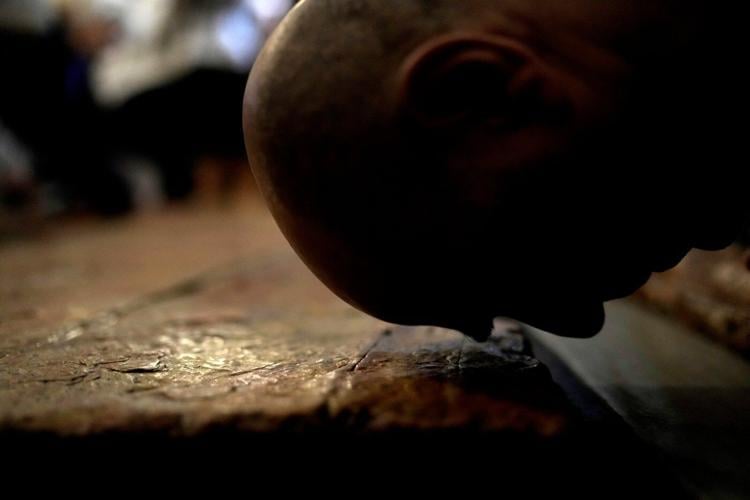
Peter Stängle, a pilgrim from Brazil, repeatedly prayed on his knees. His tattooed forearms and his forehead rested on the stone of the unction, where Jesus’s body is believed to have been prepared for burial.
“A lot is going through my mind — what I did wrong in my life, is there salvation for everybody, maybe even for me?� he said.
He'd been so distracted by the stream of visitors during the day — even though it's a far tinier number than before the , the and the decimated tourism — that he considered hiding at closing time in one of the many side chapels. Then he discovered he could simply sign up to spend the night in prayer in the church.
The complex was mostly built in the Middle Ages on sites venerated since the 4th century. With renovations and additions still ongoing, our steps echoed on millennia-old stones while 20th-century wall mosaics glittered.
It's a multistory, meandering construction decorated in the different styles of the denominations that use it. In addition to their dedicated altars, all pilgrims tend to venerate three spots — the unction stone, the shrine built over Jesus' tomb, and the upper chapel of Calvary, where a stone marks the spot where Jesus’ cross stood, according to tradition.
Stängle and I sat facing it for a long time. Only a handful of oil lamps flickered in the shade of the side-by-side Catholic and Greek Orthodox spaces, with glass enclosures dividing the stone for their respective worshippers' veneration.
We also crossed paths in front of the Holy Edicule, the marble shrine erected over Jesus’ cave tomb. Three Armenian pilgrims sat solemnly in front of it until a cat strolled up and nestled at their feet, almost touching the beads of the rosary that one white-veiled woman held.
Different Christian traditions share holy worship spaces
It’s at the Edicule that each night around midnight, after the ringing of the bells, the first services are held as the resident clergy start the prayers that wrap up usually around 6 a.m. That's normally when we overnighters are let out, and daytime worshippers can come in.
The reverence, said the Rev. Giuseppe Gaffurini, “enriches the Basilica.�
“You can still breathe in the presence of he who was crucified and rose from the dead," said Gaffurini, who heads the monastic community of 10 Franciscans living in rooms above the Catholic section of the church.
The Italian priest laments that the ongoing conflicts have prevented hundreds of thousands of pilgrims from attending services at the basilica. He had often admired their devotion — those touching or kissing the cold, historic stones, and those hugging each other in tears.
He remembers first visiting to chant in some of the nighttime liturgies 15 years ago. He had taken monastic vows three decades earlier, so he didn’t expect it to be a transformative experience — but it was so searing that he hasn’t left.
“The joy of the encounter at the sepulcher of the risen one erases a lifetime of fatigue and launches you forward again,� Gaffurini said.
He then retired to his room for a few hours’ sleep before the Franciscans’ dawn services started, his brown robes fading in the candlelit space.
A fellow friar from Guinea-Bissau was the first up from the Catholic order. He rang a bell and opened the Catholic chapel of the — where Franciscans have worshipped for 700 years — so that priests of the Greek Orthodox, Armenian and Coptic rites could incense it on their around-midnight tour of the sacred spots inside the church. Ethiopian and Syrian Orthodox clergy also have clearly defined access to the church in an often controversial 19th-century arrangement.
The Franciscan, a Greek Orthodox priest and an Armenian one robed in bright red, nodded at each other as incense wafted near the Edicule. Then each started in rotation — an accommodating coexistence that’s a welcome change from centuries of at-times violent fights about the right to worship here.
“We’re living a particularly positive period of relationships with the other churches,� said the Rev. Francesco Ielpo, the Franciscan priest who, as Custos of the Holy Land, oversees more than 300 friars in the region ministering to the basilica and many more holy sites.
That positivity and collaboration, he says, "is, I believe, the first and most important sign to be really prophets of peace.�
At night, clergy and pilgrims are alone with their thoughts — and faith
Before the latest wars, the shop-filled maze of narrow alleyways that surround the church inside Jerusalem's Old City was often packed shoulder-to-shoulder with jostling pilgrims. On a 2016 trip here, the crowds were so dense I didn't even make it into the basilica's stone courtyard.
A team of archaeologists and a few groups of visitors still come in daily, crossing paths with Jews and Muslims going to pray at their respective major holy sites a few hundred meters (yards) away. For the Christian priests, nuns and monks who can be easily spotted because of their flowing robes, those encounters are .
But inside the church, especially in the silent wake, you're alone with your thoughts — and for Christians, with an almost tangible representation of the central tenet of the faith.
You’re locked inside a cool, dark space, on the very site where Jesus suffered a brutal form of execution, the crucifixion. And yet, to believers, this is also where that page turned — where he defeated death, leaving the promise of eternal life for the faithful.
As we sat on a bench below the Calvary chapel — across from a 17-year-old Armenian priest on one of his first nights here — I asked Gaffurini if this mystery still affected him after 15 years.
“Fifteen?� he shot back. “It would still do so after 50 years.�
___
Associated Press religion coverage receives support through the AP’s with The Conversation US, with funding from Lilly Endowment Inc. The AP is solely responsible for this content.