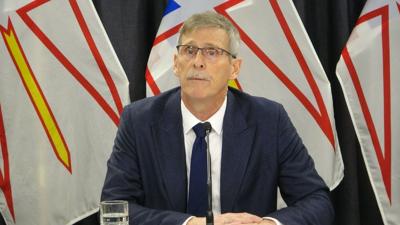
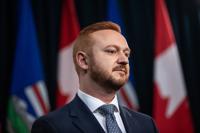
Newfoundland and Labrador Finance Minister Craig Pardy addresses reporters after providing an update on the province's finances, in St. John's, N.L., on Tuesday, Dec. 16, 2025. THE CANADIAN PRESS/Sarah Smellie
Newfoundland and Labrador Finance Minister Craig Pardy addresses reporters after providing an update on the province's finances, in St. John's, N.L., on Tuesday, Dec. 16, 2025. THE CANADIAN PRESS/Sarah Smellie
ST. JOHN'S - Newfoundland and Labrador's deficit is expected to climb to $948 million by the end of March, as the province faces swelling healthcare costs and falling oil prices.
The province's newly installed Progressive Conservative government said Tuesday that the deficit will push the net debt to $19.9 billion by the end of the current fiscal year. Interest and other debt servicing fees will cost around $1.1 billion, which is about 10 per cent of the province's budget.
Finance Minister Craig Pardy described the figures as "deeply troubling," laying the blame at the feet of the previous Liberal government.
"We didn't create these numbers, we've inherited these numbers," he told reporters in St. John's, N.L.
Pardy would not say if his government was reconsidering any of the costly promises it made during the provincial election campaign earlier this year.
"All I would say to you is that we're focused on our three pillars of what we promised the residents of Newfoundland and Labrador," he said when pressed by reporters. Those pillars are better health care, lower taxes and safer communities, Pardy said.
The Progressive Conservatives won a slim majority in the October election, ending 10 years of Liberal governments in Canada's easternmost province. Tuesday's update provided the first look at the provincial finances since the Tories took office.
The previous Liberal government's budget for the current fiscal year initially forecasted a deficit of $372 million. The Liberals revised that figure to $626 million in August.
The province is home to roughly 545,000 people and it has long struggled to balance its books. In the 76 years since Newfoundland and Labrador joined Canada, the province has posted 10 budget surpluses, six of which were driven by oil royalties, according to Wade Locke, a retired economics professor at Memorial University in St. John's.
Officials said health-care costs were more than $400 million higher than forecast when the Liberals delivered the budget last year. The increase comes from more spending on nurses from private agencies and more people seeking care.
The government will also collect fewer royalties than expected from the four offshore oil installations off the east coast of Newfoundland, officials said. The Liberals had built the budget with a forecasted average oil price of US$73 per barrel. The Tories said Tuesday that figure was reduced to US$66.
The Progressive Conservatives made many campaign promises, including a pledge to raise the basic personal income tax exemption to $15,000. The change would cost about $93 million, the party has said.
Asked if the Tories were still willing to spend that money, Pardy was vague.
"All I can say is that we're going to honor our three priorities through planning for the immediate, the medium and the long term," he said.
He said the Progressive Conservative government has begun planning for the province's next budget, which will cover the 2026-27 fiscal year, which begins April 1, 2026.
Liberal Leader John Hogan took aim at Pardy's claims that the government would focus on "smart spending" to curb the growing the deficit, saying the minister "could not commit" to fulfilling the Tories' election promises.
"When he said he was surprised at the economic situation of the province, I don't buy that," Hogan said. "The former minister of finance publicly told the province where we were ... we could see where oil was going over the course of the last few months."
NDP Leader Jim Dinn used a popular Newfoundland and Labrador expression to say he felt things were going wrong.
"The arse is gone out of 'er," he told reporters, saying the government provided a fiscal update with no plan to address any problems.
"'Stay tuned' is not good enough," Dinn said.
This report by 好色tvwas first published Dec. 16, 2025.