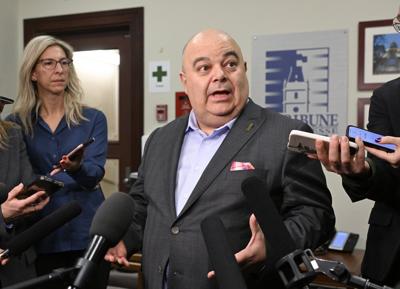
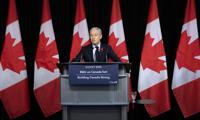
Dr. Marc-Andre Amyot, president of the Federation of General Practitioners of Quebec, responds to reporters questions at the legislature in Quebec City, Thursday, Nov. 13, 2025. THE CANADIAN PRESS/Jacques Boissinot
Dr. Marc-Andre Amyot, president of the Federation of General Practitioners of Quebec, responds to reporters questions at the legislature in Quebec City, Thursday, Nov. 13, 2025. THE CANADIAN PRESS/Jacques Boissinot
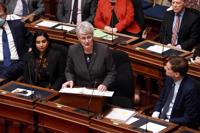
MONTREAL - Quebec's new health minister was sworn in on Friday, a day after Christian Dub茅 resigned from the role and quit the Coalition Avenir Qu茅bec party over changes to a doctor-pay law he had championed in the legislature.
The ceremony for Sonia B茅langer took place shortly after the federation of Quebec family doctors said its members had voted 97 per cent in favour of an agreement in principle 鈥� which waters down the law 鈥� with the provincial government.
Now it will be up to B茅langer to work with doctors to modify the legislation, which is scheduled to take effect Feb. 28.
"There is a firm commitment on both sides to make care and services accessible to the people of Quebec," B茅langer told reporters after she was sworn in. 鈥淭his will be my priority in the coming hours and days.鈥�
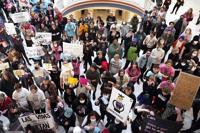
Dub茅 and the CAQ had pushed through the controversial doctor-pay law in October, leading to widespread protests by doctors, many of whom had threatened to leave the province. The legislation ties part of physicians' remuneration to performance targets and threatens steep fines for those who use pressure tactics to boycott the changes.
But recently Premier Fran莽ois Legault had moved Dub茅 aside to take over negotiations with doctors, resulting in a deal to water down the law. Among the elements removed are performance-related penalties and a plan that would have assigned all Quebecers to a health-care provider by 2027. Instead, the new deal offers incentives for doctors to enrol 500,000 new patients by June 2026.聽
As well, the draft agreement maintains changes to the method of remuneration for physicians, but removes the threat of heavy fines for doctors who take 鈥渃oncerted actions鈥� to oppose the law.
On Thursday, Dub茅 concluded he was no longer the person to lead the Health Department and to rewrite the law he had shepherded through the national assembly. He took responsibility for some mistakes and a sometimes tense tone in discussions with physicians.
In a letter announcing his departure, Dub茅 said the law he had adopted aimed to modernize the governance structure between the government, the family doctor federation and medical directors in the health network. But the new five-year pact Legault struck with the federation, he said, "essentially maintains the status quo on governance issues."
The province, meanwhile, is still negotiating with the federation representing medical specialists.
After offering a terse statement following Dub茅's abrupt departure, Legault on Friday offered a fuller response.
"As premier, I felt we had gone far enough and that it was time to reach an agreement with the doctors to avoid further damaging the health-care system," Legault wrote on social media. "I therefore took back control of the negotiations with the two medical federations, with the help of (Treasury Board President) France-脡laine Duranceau, so that we could focus on the important changes that needed to be made to improve services for citizens."
The federation representing Quebec's family doctors welcomed the 97 per cent result from its members. "The agreement will notably allow for changes to the remuneration model for family physicians, improved funding for telemedicine, and the stabilization of clinics that rely on the family medicine group program," the federation said in a statement Friday.
"Family physicians will therefore be able to continue practising high-quality family medicine and focus on what they do best: caring for the people of Quebec."
This report by 好色tvwas first published Dec. 19, 2025.