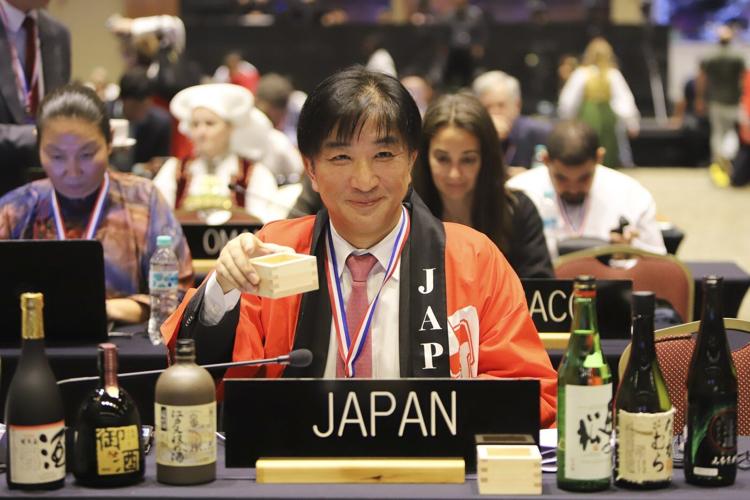
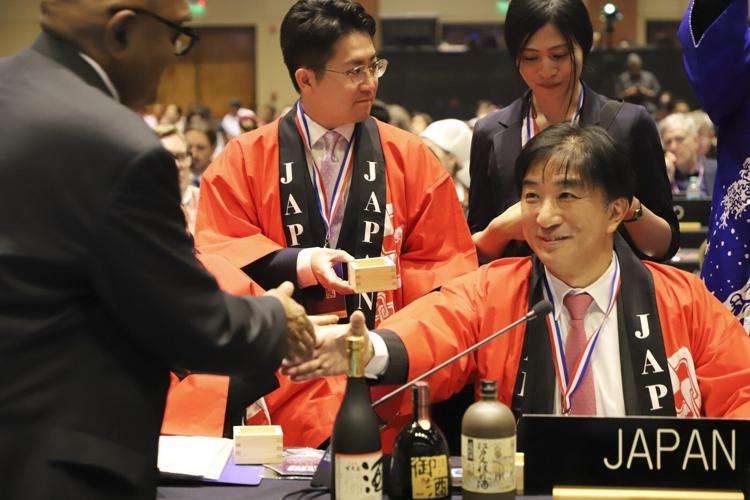
Japan's Takehiro Kano, ambassador to UNESCO, reacts the traditional Japanese brewing of sake was named Intangible Cultural Heritage during a UNESCO World Heritage Convention in Asuncion, Paraguay, Wednesday, Dec. 4, 2024. (AP Photo/Marta Escurra)
Japan's Takehiro Kano, ambassador to UNESCO, reacts after the traditional Japanese brewing of sake was named Intangible Cultural Heritage during an UNESCO World Heritage Convention in Asuncion, Paraguay, Wednesday, Dec. 4, 2024. (AP Photo/Marta Escurra)
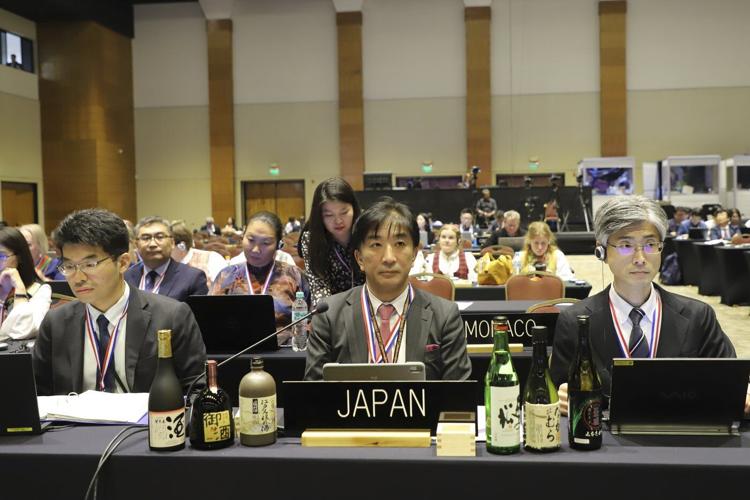
Part of Japan's delegation from left to right; Shuntaro Yoshino, Takehiro Kano, and Hidetaka Kinami, attend a UNESCO World Heritage Convention, where the traditional Japanese brewing of sake is listed as a nominee for Intangible Cultural Heritage, in Asuncion, Paraguay, Wednesday, Dec. 4, 2024. (AP Photo/Marta Escurra)
Japanese sake, that is listed as a nominee for Intangible Cultural Heritage, are displayed on Japan's delegation table, during an UNESCO World Heritage Convention, in Asuncion, Paraguay, Wednesday, Dec. 4, 2024. (AP Photo/Marta Escurra)
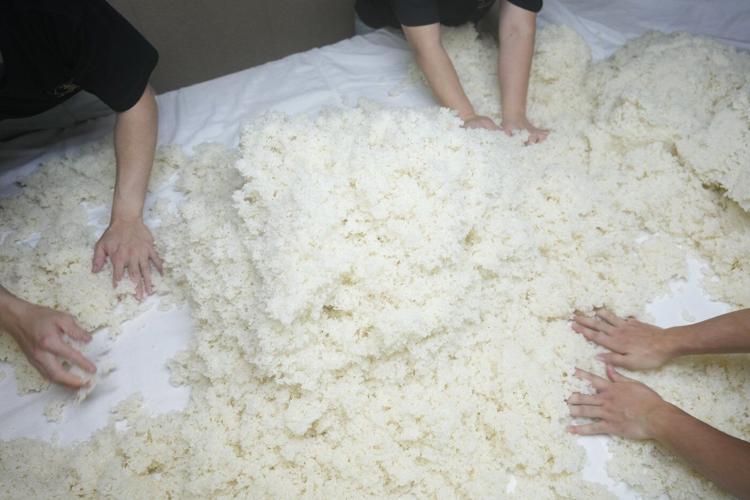
Sake brewer Mie Takahashi, back right, and her crew Daichi Ushiyama, right, and Tatsuya Ogawa prepare steamed rice with koji mold for sake making in a temperature-controlled room at the Koten sake brewery in Okaya, Nagano prefecture, central Japan, Saturday, Nov. 30, 2024. (AP Photo/Hiro Komae)
Seasonal employee Shigeru Kikuchi stirs "moromi," or fermentation mash, following the mixture of sake ingredients including steamed rice with koji mold and yeast, in a sake making process at the Koten sake brewery in Okaya, Nagano prefecture, central Japan, Saturday, Nov. 30, 2024. (AP Photo/Hiro Komae)
Japan's Takehiro Kano, ambassador to UNESCO, reacts the traditional Japanese brewing of sake was named Intangible Cultural Heritage during a UNESCO World Heritage Convention in Asuncion, Paraguay, Wednesday, Dec. 4, 2024. (AP Photo/Marta Escurra)
NP
Japan's Takehiro Kano, ambassador to UNESCO, reacts after the traditional Japanese brewing of sake was named Intangible Cultural Heritage during an UNESCO World Heritage Convention in Asuncion, Paraguay, Wednesday, Dec. 4, 2024. (AP Photo/Marta Escurra)
NP
Part of Japan's delegation from left to right; Shuntaro Yoshino, Takehiro Kano, and Hidetaka Kinami, attend a UNESCO World Heritage Convention, where the traditional Japanese brewing of sake is listed as a nominee for Intangible Cultural Heritage, in Asuncion, Paraguay, Wednesday, Dec. 4, 2024. (AP Photo/Marta Escurra)
NP
Japanese sake, that is listed as a nominee for Intangible Cultural Heritage, are displayed on Japan's delegation table, during an UNESCO World Heritage Convention, in Asuncion, Paraguay, Wednesday, Dec. 4, 2024. (AP Photo/Marta Escurra)
NP
Sake brewer Mie Takahashi, back right, and her crew Daichi Ushiyama, right, and Tatsuya Ogawa prepare steamed rice with koji mold for sake making in a temperature-controlled room at the Koten sake brewery in Okaya, Nagano prefecture, central Japan, Saturday, Nov. 30, 2024. (AP Photo/Hiro Komae)
hk
Seasonal employee Shigeru Kikuchi stirs "moromi," or fermentation mash, following the mixture of sake ingredients including steamed rice with koji mold and yeast, in a sake making process at the Koten sake brewery in Okaya, Nagano prefecture, central Japan, Saturday, Nov. 30, 2024. (AP Photo/Hiro Komae)
LUQUE, Paraguay (AP) — Sake is perhaps more Japanese than the world-famous sushi. It's brewed in centuries-old mountaintop warehouses, savored in the country’s pub-like izakayas, poured during weddings and served slightly chilled for special toasts.
The that plays a crucial role in Japan's culinary traditions was enshrined on Wednesday by on its list of the “intangible cultural heritage of humanity."
At a meeting in Luque, Paraguay, members of UNESCO’s committee for safeguarding humanity's cultural heritage voted to recognize 45 cultural practices and products around the world, including Brazilian white cheese, Caribbean cassava bread and Palestinian olive oil soap.
Unlike UNESCO’s World Heritage List, which includes sites considered important to humanity like the Pyramids of Giza in Egypt, the Intangible Cultural Heritage designation names products and practices of different cultures that are deserving of recognition.
A Japanese delegation welcomed the announcement in Luque.
“Sake is considered a divine gift and is essential for social and cultural events in Japan,� Takehiro Kano, the Japanese ambassador to UNESCO, told The Associated Press.
The basic ingredients of sake are few: rice, water, yeast and koji, a rice mold, which breaks down the starches into fermentable sugars like malting does in beer production. The whole two-monthlong process of steaming, stirring, fermenting and pressing can be grueling.
The rice — which wields tremendous marketing power as part of Japan's broader cultural identity — is key to the alcoholic brew.
For a product to be categorized Japanese sake, the rice must be Japanese.
The UNESCO recognition, the delegation said, captured more than the craft knowledge of making high-quality sake. It also honored a tradition dating back some 1,000 years — sake makes a cameo in Japan’s famous 11th century novel, “The Tale of Genji,� as the drink of choice in the refined Heian court.
Now, officials hope to restore sake's image as Japan's premier alcoholic drink even as the younger drinkers in the country switch to imported wine or domestic beer and whiskey.
“It means a lot to Japan and to the Japanese,� Kano said of the UNESCO designation. "This will help to renew interest in traditional sake elaboration.�
In Tokyo, Hitoshi Utsunomiya, the director of the Japan Sake and Shochu Makers Association, a trade group, agreed. “I hope that this will also be an opportunity for Japanese people to take another look at sake, shochu and awamori, which are the essence of their culture. I would like them to try it even once and see what it tastes like,� he said.
Japanese Prime Minister Shigeru Ishiba, in a statement, said he was “delighted� by the inscription of traditional sake-making, the traditional technic that Japan is proud of. Ishiba congratulated those who dedicated to preserving and promoting the tradition.
Also, that the listing could give a little lift to the country's export economy as the popularity of sake booms around the world and in the United States amid heightened interest in Japanese cuisine.
Sake exports, mostly to the U.S. and China, now rake in over $265 million a year, according to the association.
Japan's delegation appeared ready to celebrate on Wednesday — in classic Japanese style.
After the announcement, Kano raised a cypress box full of sake to toast the alcoholic brew and cultural rite.
___
This story corrects the surname of the Japanese official to Kano instead of Takehiro.