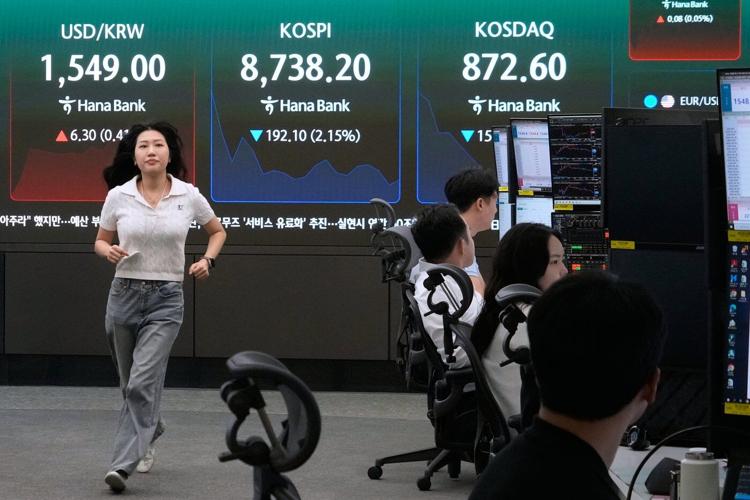
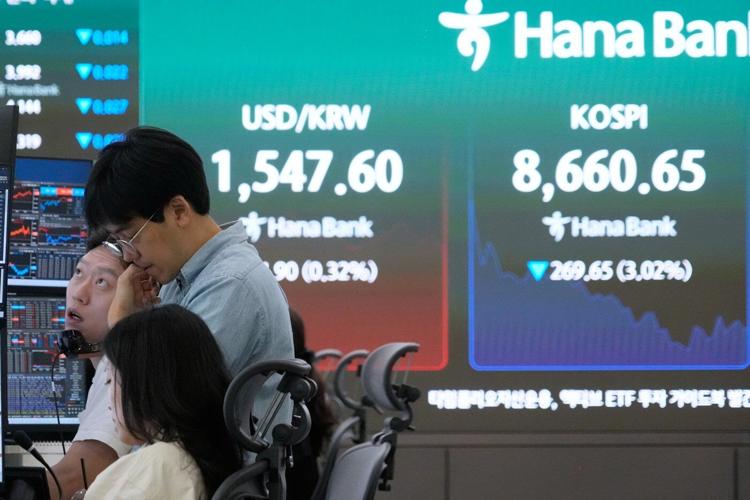
A currency trader passes by a screen showing the Korea Composite Stock Price Index (KOSPI) and the foreign exchange rate between U.S. dollar and South Korean won at the foreign exchange dealing room of the Hana Bank headquarters in Seoul, South Korea, Friday, June 26, 2026. (AP Photo/Ahn Young-joon)
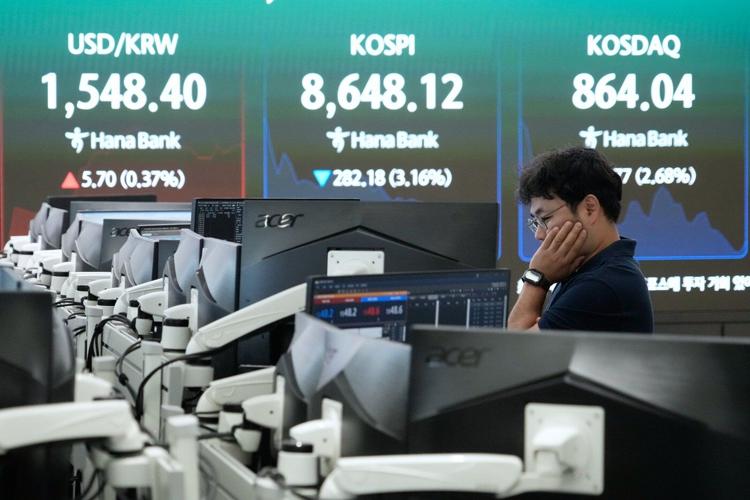
A currency trader watches monitors near a screen showing the Korea Composite Stock Price Index (KOSPI) and the foreign exchange rate between U.S. dollar and South Korean won at the foreign exchange dealing room of the Hana Bank headquarters in Seoul, South Korea, Friday, June 26, 2026. (AP Photo/Ahn Young-joon)
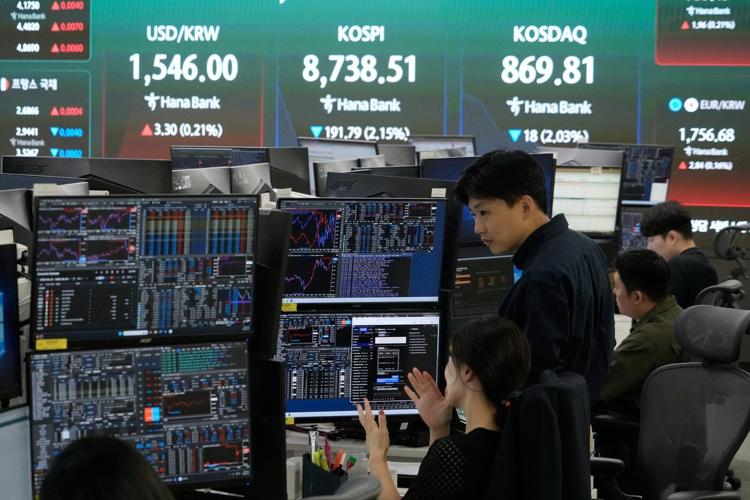
Currency traders work near a screen showing the Korea Composite Stock Price Index (KOSPI) and the foreign exchange rate between U.S. dollar and South Korean won at the foreign exchange dealing room of the Hana Bank headquarters in Seoul, South Korea, Friday, June 26, 2026. (AP Photo/Ahn Young-joon)
Currency traders work near a screen showing the Korea Composite Stock Price Index (KOSPI) and the foreign exchange rate between U.S. dollar and South Korean won at the foreign exchange dealing room of the Hana Bank headquarters in Seoul, South Korea, Friday, June 26, 2026. (AP Photo/Ahn Young-joon)
A currency trader passes by a screen showing the Korea Composite Stock Price Index (KOSPI) and the foreign exchange rate between U.S. dollar and South Korean won at the foreign exchange dealing room of the Hana Bank headquarters in Seoul, South Korea, Friday, June 26, 2026. (AP Photo/Ahn Young-joon)
AY
A currency trader watches monitors near a screen showing the Korea Composite Stock Price Index (KOSPI) and the foreign exchange rate between U.S. dollar and South Korean won at the foreign exchange dealing room of the Hana Bank headquarters in Seoul, South Korea, Friday, June 26, 2026. (AP Photo/Ahn Young-joon)
AY
Currency traders work near a screen showing the Korea Composite Stock Price Index (KOSPI) and the foreign exchange rate between U.S. dollar and South Korean won at the foreign exchange dealing room of the Hana Bank headquarters in Seoul, South Korea, Friday, June 26, 2026. (AP Photo/Ahn Young-joon)
AY
Currency traders work near a screen showing the Korea Composite Stock Price Index (KOSPI) and the foreign exchange rate between U.S. dollar and South Korean won at the foreign exchange dealing room of the Hana Bank headquarters in Seoul, South Korea, Friday, June 26, 2026. (AP Photo/Ahn Young-joon)
AY
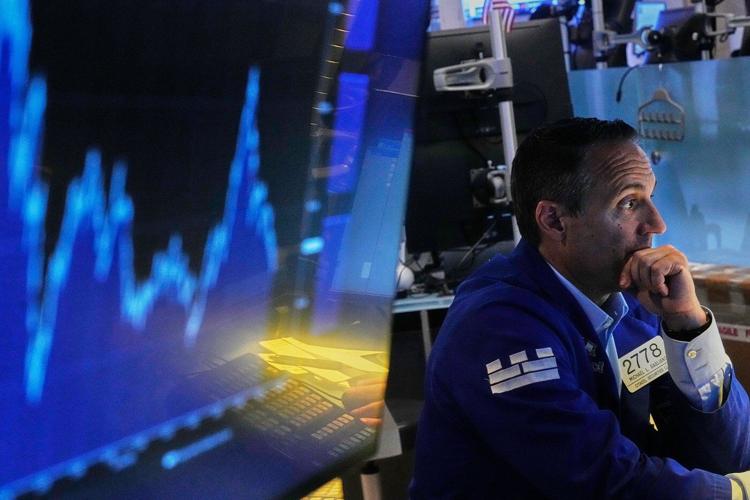
Specialist Michael Gagliano works at his post on the floor of the New York Stock Exchange, Thursday, June 25, 2026. (AP Photo/Richard Drew)
NEW YORK (AP) — AI stocks are veering back down the roller coaster and pulling Wall Street behind them. The S&P 500 fell 0.6% early Friday and is heading for just its second losing week in the last 13. The Nasdaq composite, which has a heavy emphasis on tech stocks, was down 1%. The Dow Jones Industrial Average was down a more modest 103 points, or 0.2%. The slump started in Asia, where stock indexes tumbled 4.2% in Japan and 5.8% in South Korea. There, as well, the culprits were stocks of companies that have been swept up in the mania around artificial-intelligence technology.
THIS IS A BREAKING NEWS UPDATE. AP’s earlier story follows below.
Wall Street pointed toward losses before the opening bell Friday as volatility continued for chipmakers and other companies heavily invested in artificial intelligence.
Futures for the S&P 500 lost 0.6% while futures for the Dow Jones Industrial Average edged 0.2% lower. Nasdaq futures tumbled another 1.4% and are on track for a more than 5% loss this week, the second such wipeout this month.
AI stocks broadly have been because of worries that their profits can’t possibly keep pace with the .
In premarket trading Friday, Micron fell 5%, Intel was down 3.6% and Broadcom and Qualcomm both retreated close to 2%.
The growing later this year because of has helped deflate the massive run-up in AI-related stocks in recent days as traders worry that the higher rates could hamper economic growth.
It was a similar story in Asia, where technology stocks also have seen wild swings recently.
Tokyo’s Nikkei 225 index shed 4.2% to 69,360.88 and the Kospi in Seoul plunged 5.8% to 8,411.21. Both recovered some ground lost earlier in the day.
The wide swings in Tokyo and Seoul are typical of recent volatility in markets as investors react to the and other investments. Shares in Japan and South Korea hit records this week and logged strong gains on Thursday after chipmakers Qualcomm and Micron Technology reported better than expected earnings.
In South Korea, market trends have been dominated by movements in stock in Samsung Electronics, the country’s biggest company, and chipmaker SK Hynix, which like Samsung is collaborating with Nvidia on artificial intelligence.
Given that concentration, “a strong Micron print can produce a powerful upside chase one day; a new concern around memory costs, capex, or the durability of AI demand can reverse it violently the next,� Stephen Innes of SPI Asset Management said in a commentary.
Samsung’s shares lost 5.3% on Friday, while those of SK Hynix fell 8.4%. In Tokyo trading, technology giant SoftBank Group Corp. lost 12.5% and computer chip testing equipment maker Advantest sank 3.2%.
Hong Kong’s Hang Seng lost 1.8% to 22,667.13, while the Shanghai Composite index slipped 2.3% to 4,027.26.
In Australia, the S&P/ASX 200 was an outlier, gaining 0.2% to 8,764.20.
Taiwan’s Taiex gave up 3.6%.
While the AI boom regularly roils tech shares, other sectors have held relatively steady, noted Thomas Mathews of Capital Economics.
“Even if the AI boom turned into a bust the ‘non-tech’ parts of the stock market could conceivably shrug it off for a while, as they have this week,� he wrote in a report.
Elsewhere, at midday in Europe, Germany's DAX gave up 1.3%, while the CAC 40 in Paris lost 0.8%. Britain's FTSE 100 shed 0.9%.
Oil prices drifted even closer to their levels leading up to the U.S. and Israel's war with Iran.
The price for a barrel of Brent crude oil, the international standard, declined $1.85 to $73.65 early Friday. It has fallen from its highs above $100 caused by the closure of the , which slowed the global flow of oil.
U.S. benchmark crude oil lost $1.62 to $70.30 a barrel. It was around $67 a barrel in the days leading up to the war in late February.