LONDON (AP) — Prime Minister Rishi Sunak said Britain is descending into “mob rule” because of the pressures created by protests against the Israel-Hamas war — words criticized as alarmist by a human rights group.
Sunak told a meeting of police leaders on Wednesday that there was a ”pattern of increasingly violent and intimidatory behavior” that’s intended to “shout down free debate and stop elected representatives doing their job.”
“There is a growing consensus that mob rule is replacing democratic rule,” he said, according to a transcript released by the prime minister’s office. “And we’ve got to collectively, all of us, change that urgently.”
Tom Southerden of Amnesty International said Thursday that talk of mob rule “wildly exaggerates the issue and risks delegitimizing the rights of peaceful protest.”
have drawn hundreds of thousands of people to central London almost weekly to call for a cease-fire in a conflict that has killed Palestinians, according to the Gaza Health Ministry in the Hamas-run territory. Israel says Hamas killed 1,200 Israelis, mostly civilians, and abducted roughly 250, in the Oct. 7 attack.
The protests have been overwhelmingly peaceful, though there have been dozens of arrests over signs and chants allegedly supporting Hamas, a banned organization in Britain. Jewish organizations and many lawmakers say the mass marches have created an intimidating atmosphere for Jewish Londoners — though members of the Jewish community have been among those on pro-cease-fire marches.
have , with some lawmakers saying they fear for their safety after receiving threats over their positions on the war. Reports of both antisemitic and anti-Muslim abuse in Britain have soared since Hamas’ Oct. 7 attack on Israel, which triggered Israel’s invasion of Gaza.
A debate last week in the House of Commons on whether to call for a cease-fire amid allegations the speaker of the house had bent parliamentary rules in response to pressure from pro-Palestinian activists.
During the debate, protesters projected “ — a slogan some see as calling for the destruction of Israel — onto Parliament’s Big Ben clocktower.
On Saturday, Sunak suspended from the party for saying London Mayor Sadiq Khan, who is Muslim, was controlled by Islamists and had allowed them to take charge of the city.
Pro-Palestinian demonstrators protested at the house of a Conservative lawmaker earlier this month, while environmental activists have targeted Sunak’s family home in northern England.
The prime minister met police chiefs after announcing a 31-million-pound ($40-million) fund to step up security for lawmakers after politicians reported threats and intimidation connected to the war.
At Wednesday’s meeting, the government told police chiefs that protests at politicians’ homes “should generally be considered to be intimidatory.”
Sunak told officers to take a “robust approach … to protect our democratic processes from intimidation, disruption, from subversion.”
British lawmakers have a tradition of meeting regularly with constituents in their local communities, but security has been tightened after several attacks in the last decade. In 2016, Labour lawmaker Jo Cox by a far-right extremist, and Conservative David Amess in 2021 by an attacker inspired by the Islamic State group.
Sunak's comments follow several years of increasingly stringent by the Conservative government. It has to clamp down on broadly defined “public nuisance,” punishable by up to 10 years in prison, and giving police more powers to restrict protests judged to be disruptive. Hundreds of have been arrested and sometimes jailed for blocking roads and other nonviolent acts.
“Freedom of expression and assembly are absolutely fundamental rights in any free and fair society,” said Southerden, law and human rights director at Amnesty U.K.
“The U.K. has undergone a major crackdown on protest rights in recent years, with peaceful protest tactics being criminalized and the police being given sweeping powers to prevent protests taking place,” he said.
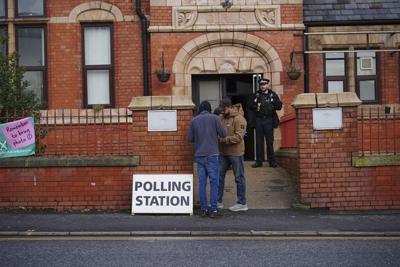
Voters in the town of Rochdale in northwest England went to the polls Thursday to elect a lawmaker, after a chaotic special election campaign dominated by the Gaza war. The Labour Party , Azhar Ali, for claiming that Israel allowed Hamas’ Oct. 7 attack to happen as a pretext .
His name remains on the ballot, alongside candidates including George Galloway, a former Labour lawmaker who is campaigning against Labour’s stance on the Israel-Hamas war, and Simon Danczuk, yet another former Labour legislator who now represents the right-wing Reform U.K.