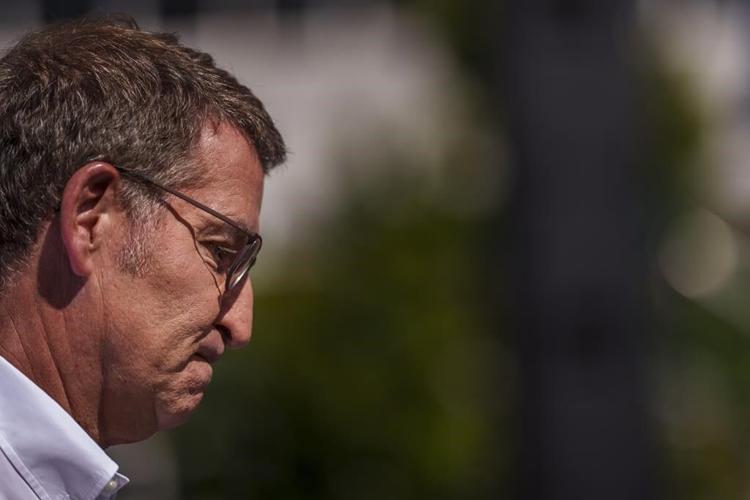
Alberto Feijoo, leader of the mainstream conservative Popular Party, arrives for a meeting in Madrid, Spain, Sunday, Sept. 24, 2023. The leader of Spain's conservatives will have his opportunity to form a new government this week in what has been preordained as a lost cause given his lack of support in the Parliament. Alberto Nunez Feijoo's Popular Party won the most seats from inconclusive elections in July but fell well short of a majority. (AP Photo/Manu Fernandez)
The leader of Spain's Popular Party Alberto Nunez Feijoo waves during his arrival at the Spanish parliament's lower house in Madrid, Spain on Tuesday, Sept. 26, 2023. The leader of Spain's conservatives will have his opportunity to form a new government this week in what has been preordained as a lost cause given his lack of support in the Parliament. (AP Photo/Bernat Armangue)
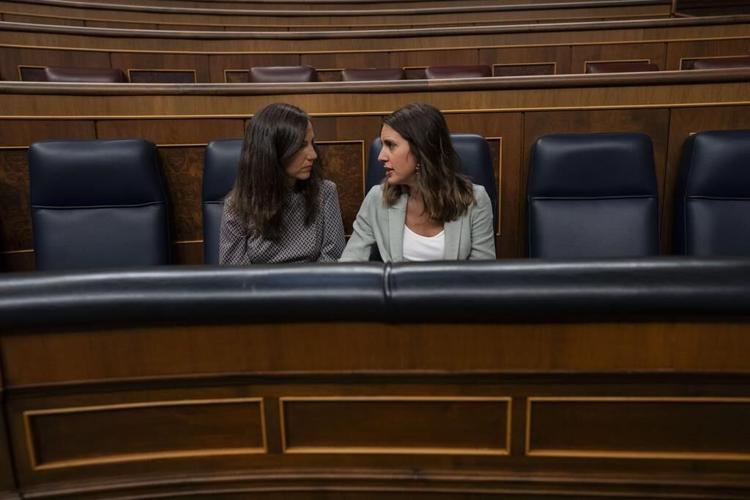
Ione Belarra, acting minister of social rights, left, and Irene Montero, acting minister of equality talk at the Spanish parliament's lower house in Madrid, Spain on Tuesday, Sept. 26, 2023. The leader of Spain's conservatives is trying to win the endorsement of the nation's Parliament to form a new government. Alberto Núñez Feijóo's Popular Party won the most seats after inconclusive July 23 national elections that left all parties well shy of an absolute majority. Feijóo faces two investiture votes — one on Wednesday and then again on Friday — that will determine whether he can become prime minister. (AP Photo/Bernat Armangue)
Alberto Feijoo, leader of the mainstream conservative Popular Party, arrives for a meeting in Madrid, Spain, Sunday, Sept. 24, 2023. The leader of Spain's conservatives will have his opportunity to form a new government this week in what has been preordained as a lost cause given his lack of support in the Parliament. Alberto Nunez Feijoo's Popular Party won the most seats from inconclusive elections in July but fell well short of a majority. (AP Photo/Manu Fernandez)
MF
The leader of Spain's Popular Party Alberto Nunez Feijoo waves during his arrival at the Spanish parliament's lower house in Madrid, Spain on Tuesday, Sept. 26, 2023. The leader of Spain's conservatives will have his opportunity to form a new government this week in what has been preordained as a lost cause given his lack of support in the Parliament. (AP Photo/Bernat Armangue)
BA
Ione Belarra, acting minister of social rights, left, and Irene Montero, acting minister of equality talk at the Spanish parliament's lower house in Madrid, Spain on Tuesday, Sept. 26, 2023. The leader of Spain's conservatives is trying to win the endorsement of the nation's Parliament to form a new government. Alberto Núñez Feijóo's Popular Party won the most seats after inconclusive July 23 national elections that left all parties well shy of an absolute majority. Feijóo faces two investiture votes — one on Wednesday and then again on Friday — that will determine whether he can become prime minister. (AP Photo/Bernat Armangue)
MADRID (AP) — The leader of Spain’s conservatives is trying to convince lawmakers on Tuesday to let him form the country’s new government, a green light he is not expected to get during two rounds of voting in the Spanish parliament later this week.
Spain's gave the most seats in the parliament's 350-member lower chamber but well shy of an absolute majority, setting the stage for a difficult path to power.
Under the Spanish Constitution, two investiture votes will determine whether Feijóo has authorization to form a government — likely a coalition with the far-right Vox party. He needs approval from a simple majority of 176 lawmakers in the first vote, which is scheduled for Wednesday after hours of debate.
If he misses that mark, the bar would be lowered for the second round, in which he would need only more “yes� than “no� votes. Abstentions could sway the result in that situation. The second vote is set for Friday.
The Popular Party holds 137 seats in the Congress of the Deputies, the most of any party. But even with backing from Vox's 33 lawmakers and two from small conservative parties representing Navarra and the Canary Islands, Feijóo is still four votes short.
If he fails to win approval, would get a shot at staying in the Moncloa Palace. The center-left Socialist leader would have to round up enough support of lawmakers from a group of competing leftist, regionalist and even separatist parties.
In exchange for their support, separatist parties from northeastern Spain's Catalonia region are demanding an amnesty for possibly thousands of people involved in a failed 2017 secession bid and protests against the Spanish government's resulting crackdown. Sánchez also needs to woo rival parties from Basque Country.
Feijóo, 62, is trying to use opposition to the possible Catalan amnesty to . He started his speech to lawmakers Tuesday by accusing Sánchez of being willing to bend to the demands of the separatists, who include fugitives such as former Catalonia region leader who fled the country six years ago.
“I have within my reach the votes that I need to become prime minister,� Feijóo said to laughs from some of his left-wing rivals. “But I am not ready to accept the price I was asked to pay for them.�
A failure by Feijóo to form a government would automatically start a two-month period in which Sánchez could try to form a new government. If he also fails, parliament would be dissolved on Nov. 27 and a new election would be called for Jan. 14.