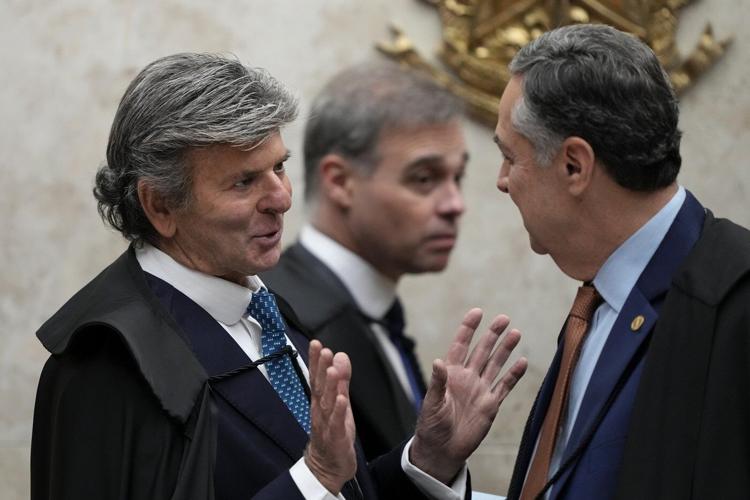
Minister Luiz Fux, left, Google Brazil’s rapporteur, talks with Supreme Court Chief Justice Roberto Barroso, during the court’s resumption of social media regulation cases regarding online disinformation, in Brasilia, Brazil, Wednesday, June 4, 2025. (AP Photo/Eraldo Peres)
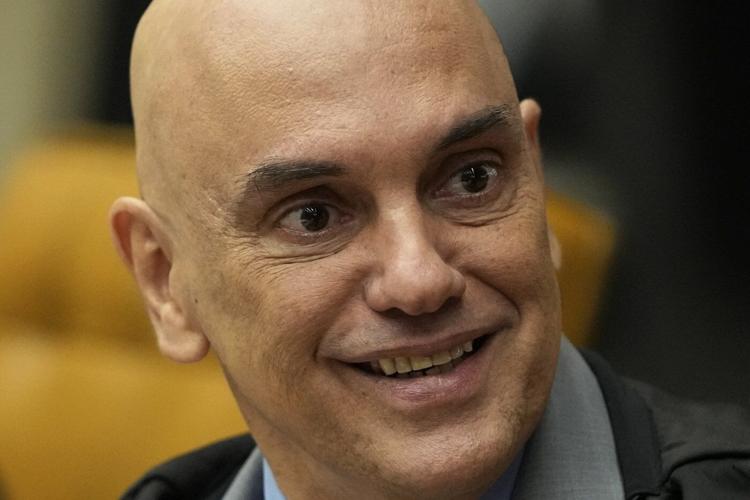
Supreme Court Justice Alexandre de Moraes attends the court’s resumption of social media regulation cases regarding online disinformation, in Brasilia, Brazil, Wednesday, June 4, 2025. (AP Photo/Eraldo Peres)
Minister Luiz Fux, left, Google Brazil’s rapporteur, talks with Supreme Court Chief Justice Roberto Barroso, during the court’s resumption of social media regulation cases regarding online disinformation, in Brasilia, Brazil, Wednesday, June 4, 2025. (AP Photo/Eraldo Peres)
EP
Supreme Court Justice Alexandre de Moraes attends the court’s resumption of social media regulation cases regarding online disinformation, in Brasilia, Brazil, Wednesday, June 4, 2025. (AP Photo/Eraldo Peres)
BRASILIA, Brazil (AP) — The majority of justices on Brazil’s Supreme Court have agreed to make social media companies liable for illegal postings by their users, in a landmark case for Latin America with implications for U.S. relations.
Brazil's top court decided to rule on two different cases to reach an understanding on how to deal with social media companies as reports of fraud, child pornography and violence among teenagers become rampant online. Critics warn such measures could threaten free speech as platforms preemptively remove content that could be problematic.
Gilmar Mendes on Wednesday became the sixth of the court’s 11 justices to vote to open a path for companies like Meta, X and Microsoft to be sued and pay fines for content published by their users. Voting is ongoing but a simple majority is all that is needed for the measure to pass.
The ruling will come after U.S. Secretary of State Marco Rubio warned of possible visa restrictions against foreign officials allegedly involved in censoring American citizens. One such official reportedly is Brazilian Justice Alexandre de Moraes, who has taken measures against social media outlets he deemed to have not complied with Brazilian law.
Mendonça said free speech on social media is key for the publication of information that "holds powerful public institutions to account, including governments, political elites and digital platforms.â€
Justice FlĂĄvio Dino, the first to vote on Wednesday, reminded his colleagues that recent cases of school shootings in Brazil were stimulated on social media. He read out postings by one user who said he was happy by watching families of dead children “weeping, bleeding, dying.â€
“I think social media has not made humanity closer to what it has produced in best fashion,†he said.
The social media proposal would become law once voting is finished and the result is published. But Brazil’s Congress could still pass another law to reverse the measure.
The current legislation states social media companies can only be held responsible if they do not remove hazardous content after a court order.
Public debate on regulating social networks increased in Brazil in the aftermath of the Jan. 8 riot in 2023, when supporters of former president Jair Bolsonaro in the capital, Brasilia.
Platforms need to be pro-active in regulating content, said Alvaro Palma de Jorge, a law professor at the Rio-based Getulio Vargas Foundation, a think tank and university.
“They need to adopt certain precautions that are not compatible with simply waiting for a judge to eventually issue a decision ordering the removal of that content,†Palma de Jorge said.
Wednesday’s ruling brings Brazil’s approach to big tech closer to the European Union’s approach, which has sought to and other digital platforms.
Rendering platforms automatically accountable for content on their platforms may infringe freedom of speech as they could resort to preemptively removing content, according to the Sao-Paulo based Brazilian Chamber of Digital Economy, an organization that represents sectors of the digital economy.
“This type of liability favors large companies with robust legal structures, to the detriment of smaller, national players, which negatively impacts competition,†said the organization, adding that the decision may increase barriers to innovation.