
CAPE CANAVERAL, Fla. (AP) — April’s total solar eclipse promises to be a scientific bonanza, thanks to new spacecraft and telescopes — and cosmic chance.
The moon will be extra close to Earth, providing a long and intense period of darkness, and the sun should be more active with the potential for dramatic bursts of plasma. Then there’s totality’s densely populated corridor .
Hundreds if not thousands of the tens of millions of spectators will double as “citizen scientists,” helping NASA and other research groups better understand our planet and star.
They’ll photograph the sun’s outer crownlike atmosphere, or corona, as the moon passes between the sun and Earth, blotting out sunlight for up to 4 minutes and 28 seconds on April 8. They’ll observe the as midday darkness falls. They’ll also measure dropping temperatures, monitor clouds and use ham radios to gauge communication disruptions.
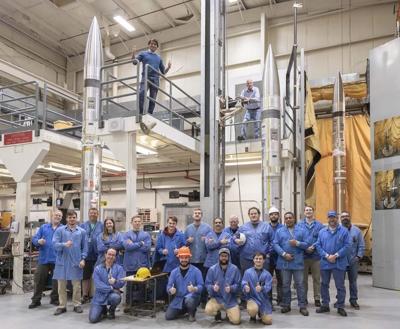
At the same time, rockets will blast off with science instruments into the electrically charged portion of the atmosphere near the edge of space known as the ionosphere. The small rockets will soar from Wallops Island, Virginia — some 400 miles outside totality but with 81% of the sun obscured in a partial eclipse. Similar launches were conducted from New Mexico during last October’s “ring of fire” solar eclipse that swept across the western U.S. and Central and South America.
“Time for the biggie! It is pretty exciting!!!” Embry-Riddle Aeronautical University’s Aroh Barjatya, the rockets’ mission director, said in an email.
NASA’s high-altitude jets also will take to the air again, chasing the moon’s shadow with improved telescopes to study the sun’s corona and surrounding dust.
“Dust sounds boring,” acknowledged NASA’s eclipse program manager Kelly Korreck. “But at the same time, dust is actually really interesting. Those are the leftover remnants from when the solar system was forming.”
More than 600 weather balloons will be launched by college students along the track, providing livestreams while studying atmospheric changes. Cloudy skies shouldn’t matter.
“Lucky for us, the balloons flying to 80,000 feet and above don’t care if it’s cloudy on the ground,” said Angela Des Jardins, an astrophysicist at Montana State University who’s coordinating the nationwide project.
And if the Federal Aviation Administration approves, a 21-foot (6.5-meter) kite will lift a science instrument three miles (5 kilometers) above Texas in an experiment by the University of Hawaii’s Shadia Habbal. She, too, wants to get above any clouds that might hamper her observations of the sun.
Normally hidden by the sun’s glare, the corona is on full display during a total solar eclipse, making it a prime research target. The spiky tendrils emanating thousands of miles (kilometers) into space are mystifyingly hotter than the sun’s surface — in the millions of degrees, versus thousands.
“In terms of the value of total eclipses, science still cannot explain how the corona is heated to such extreme temperatures,” said retired NASA astrophysicist Fred Espenak, better known as Mr. Eclipse for all his charts and books on the subject.
The U.S. won’t see another total solar eclipse on this scale until 2045, so NASA and everyone else is pulling out all the stops.
April’s eclipse will begin in the Pacific and make landfall at Mazatlan, Mexico, heading up through Texas and 14 other U.S. states before crossing into Canada and exiting into the Atlantic at Newfoundland. Those outside the 115-mile-wide (185-kilometer-wide) path, will get a partial eclipse.
Scientists got a taste of what’s to come during the 2017 total solar eclipse that stretched from Oregon to South Carolina. This time, the moon is closer to Earth, resulting in more minutes of darkness and a wider path.
“Any time we can observe for longer, that gives scientists more data,” Korreck said.
Another scientific bonus this time: The sun will be just a year away from its maximum solar activity, as opposed to 2017 when it was near its minimum. That means lots more action at the sun, possibly even a coronal mass ejection during the eclipse, with massive amounts of plasma and magnetic field blasted into space.
Plus there are two new spacecraft out there studying the sun: NASA’s Parker Solar Probe and the European Space Agency and NASA’s Solar Orbiter. They’ll join other spacecraft on eclipse duty, including the International Space Station and its astronauts.
Closer to home, April’s eclipse, unlike previous ones, will pass over three U.S. radar sites typically used for monitoring space weather. The stations will tune in to what’s happening in the upper atmosphere as the skies dim.
___
The Associated Press Health and Science Department receives support from the Howard Hughes Medical Institute’s Science and Educational Media Group. The AP is solely responsible for all content.