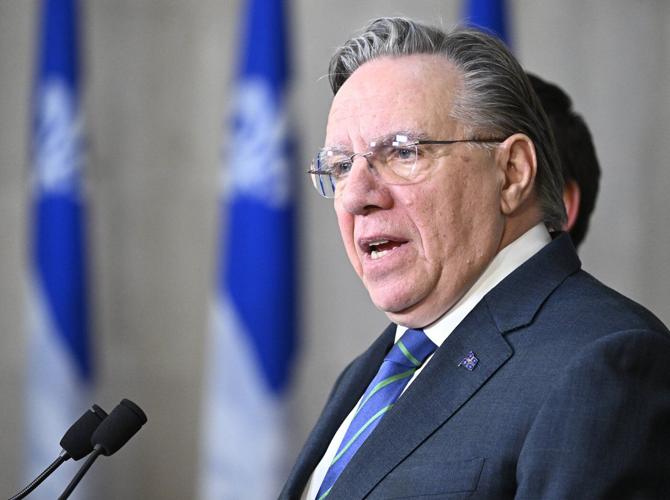
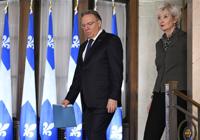
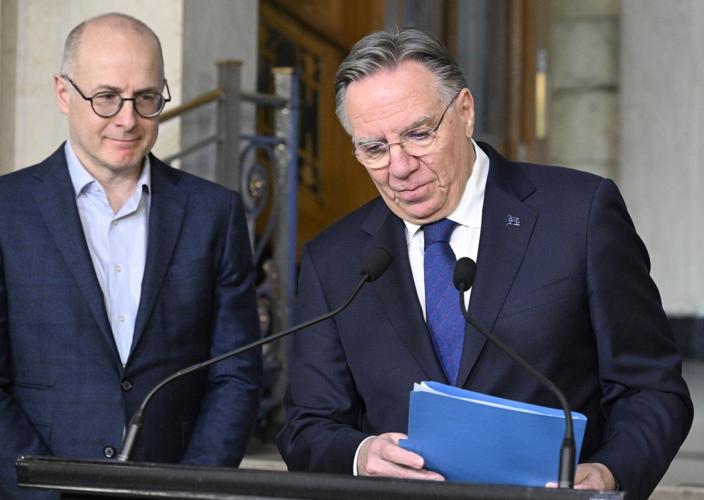
QUÉBEC - Quebec Premier François Legault announced on Wednesday he would resign after more than seven years in power, triggering a leadership race and further upending the province's political landscape with only months to go before the fall provincial election.Â
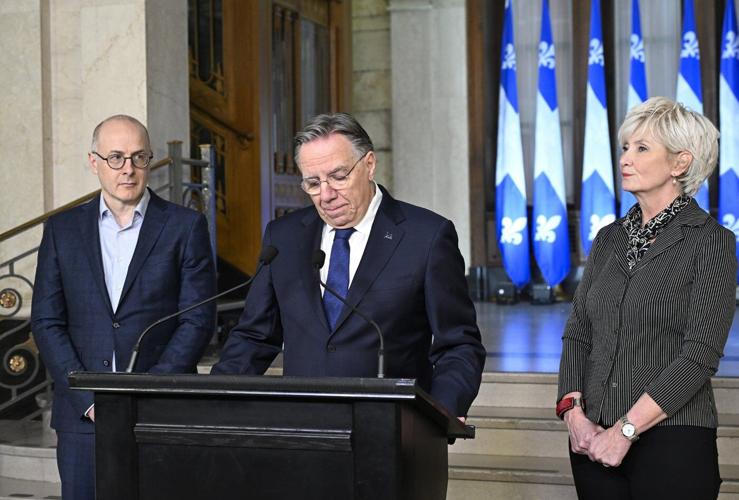
At a hastily-called news conference in Quebec City Legault told reporters he would remain in his position until a new leader is chosen for his Coalition Avenir Québec party, which he had co-founded in 2011.
"I can clearly see that right now, many Quebecers are first and foremost calling for change, including a change of premier," he said. "For the good of my party and especially for the good of Quebec, I am announcing today that I will leave my position as Quebec premier."Â
His departure adds yet more instability to a political landscape in flux, with two main parties now leaderless ahead of the general election scheduled for Oct. 5. The CAQ faces the challenge of replacing the only leader it has ever had. The provincial Liberals, meanwhile, are also in the midst of a leadership race following the resignation in December of Pablo Rodriguez after roughly six months in office.
The eventual leaders of the CAQ and the Liberals will have to rapidly mount a campaign against the PQ under Paul St-Pierre Plamondon, who has promised to hold a sovereignty referendum by 2030 if elected. His party is first in the polls and has won the last three byelections.
In a social media post announcing his resignation, Legault said he would likely remain in his position for "several months."
The Coalition Avenir Québec's executive director, Brigitte Legault, said she was hoping for a quick race. "I have no intention to drag this out for six months," she told reporters after the premier's announcement. The party's executive is expected to meet Wednesday evening to discuss the details of a leadership race.Â
While no party member has openly challenged Legault's leadership, the names circulating as possible replacements in recent months have included Education Minister Sonia LeBel, Justice Minister Simon Jolin-Barrette, Environment Minister Bernard Drainville — a former PQ cabinet minister — and Municipal Affairs Minister Geneviève Guilbault.Â
Legault had ushered in a new era in provincial politics when the CAQ won the 2018 general election, ending nearly 50 years of federalist-versus-sovereigntist Liberal and Parti Québécois rule. The 68-year-old Air Transat co-founder led his party to a second straight majority victory in 2022, buoyed by his popularity among francophones, the fragmentation of the opposition and the sustained visibility he obtained during the COVID-19 pandemic. Â
But in more recent times Legault’s party has been beset by struggles including a ballooning deficit, a scandal at the province's auto insurance board and hostile negotiations with doctors that led to the resignation of two cabinet ministers. Including Christian Dubé and Lionel Carmant — who left their cabinet posts amid the doctor talks — the party lost six legislature members in the past year, triggering speculation about Legault's future.
The party had been sitting in third in the polls, behind the PQ and the Liberals. A poll by Pallas Data for the polling aggregator Qc125 and L'Actualité published on Tuesday suggested the party has lost even more ground, putting it on par with leftist Québec solidaire. In the same survey, 75 per cent of respondents had an unfavourable impression of the premier.
In his resignation speech, Legault said he hoped that by stepping down the next election would be focused on the big challenges facing Quebec, such as the economy and protecting the French language, rather than a desire for change.Â
Legault was first recruited into politics by then-Parti Québécois leader Lucien Bouchard in 1998, before winning the Rousseau riding in that year's general election. He's been re-elected seven times. When he co-founded the CAQ in 2011 with businessman Charles Sirois, he promised to shift the political focus in the province away from the sovereignty debate and toward other priorities such as the economy.
In his speech on Wednesday, he expressed pride over his government's handling of the COVID-19 pandemic, including the effort to rapidly train thousands of care workers, as well as his work to reduce the wealth gap with neighbouring Ontario and to attract investment.
He also highlighted his efforts to ramp up electricity production with Hydro-Québec, build new seniors homes, and increase investments in health, education and culture.Â
"I can guarantee you that every day I got up telling myself, ‘I want what’s best for Quebecers.’ I didn’t always succeed, but I can guarantee that I tried — I tried very hard, with all the energy I had," he said.
Legault described politics as an "extreme sport" and thanked his wife, Isabelle Brais, and the couple's two sons for standing by his side during the highs and lows. He also thanked the party's volunteers, the larger CAQ family, and the voters who carried him to two majority mandates.
"Being premier of Quebec has been the greatest honour of my life," he concluded.
This report by ºÃÉ«tvwas first published Jan. 14, 2026.
— by Morgan Lowrie in Montreal with files from Caroline Plante in Quebec City.Â