OTTAWA - Senior federal government officials told reporters travelling to China with Prime Minister Mark Carney last week that he was accepting an invitation to join U.S. President Donald Trump's "Board of Peace."
Less than a week later, Trump said Carney's invitation had been rescinded 鈥� and the board appears to be morphing into something more ambitious than a panel focused solely on the future of Gaza.
While it's not clear exactly why Trump pulled Carney's invitation, he and other American officials have been highly critical of the prime minister's comments at the World Economic Forum in Davos, Switzerland.
Here are five things you should know about the latest dust-up in Canada-U.S. relations.
1. What was the "Board of Peace" originally meant to be?
When the Board of Peace was first announced on Jan. 16, it was presented as a body that would be tasked with overseeing the administration, reconstruction and economic recovery of Gaza 鈥� part of Trump's 20-point ceasefire plan to end the Israel-Hamas war.聽
That announcement named U.S. Secretary of State Marco Rubio, former U.K. prime minister Tony Blair and Steve Witkoff, the U.S. special envoy to the Middle East, as executive board members.
The White House announcement came after the Palestinian committee set to govern the territory under U.S. supervision met for the first time in Cairo.
2. What did Carney say about the invitation?
Carney first spoke publicly about the invitation on Sunday. He said he accepted the invitation "in principle" and that Trump first asked him about joining the board "a few weeks ago."
Carney said details were still being worked out about how the board would function and how its financing would work.
Since the original announcement, Trump has said nations will either have to pay $1 billion to secure a permanent seat on the board or be limited to a three-year term.
The prime minister said working with the board is consistent with Canada's stance on Palestine. He said his government would require "unimpeded" access to humanitarian aid in the territory and continued work toward a two-state solution as conditions for its participation on the board.
3. What changed?
While it was initially sold as part of the ceasefire plan, the board's mandate quickly began to expand.
The text of the board's charter, published by various international media outlets, says there is a "need for a more nimble and effective international peace-building body" than the UN 鈥� an institution Trump has dismissed as ineffective and dysfunctional.
Russian President Vladimir Putin has been invited to join the board, despite having launched the ongoing war in Ukraine. As of Thursday, Russia had not yet confirmed it will join.
4. Duelling views at Davos
Carney delivered a viral speech Tuesday calling on middle powers to band together against "great powers" engaging in economic coercion.
The prime minister did not mention the U.S. or Trump directly during his address at the WEF, but it drew a public rebuke from Trump the next day.
"They should be grateful to us. Canada lives because of the United States. Remember that, Mark, the next time you make your statements," Trump said Wednesday in Davos.
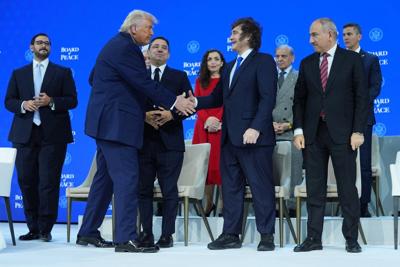
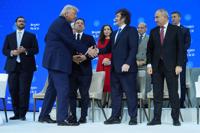
On Thursday, Trump held a Board of Peace charter signing ceremony at the WEF alongside the leaders of fewer than 20 countries.
Trump told reporters on Air Force One Thursday that some countries have put more than $1 billion toward the board. He did not name the countries.
When asked what the entrance fees are for, Trump replied, "That's a lot of money, but it's nothing compared to the value of peace."
5. Peace sells, but who's buying?聽
Trump was joined on the stage in Davos by leaders from Hungary, Argentina, Turkey, Bulgaria and Pakistan, among others.
Many world leaders, including most of America's traditional European allies, were absent.
Israeli Prime Minister Benjamin Netanyahu also announced he plans to join the board, despite his office's earlier criticism of the proposed makeup of the board鈥檚 committee tasked with overseeing Gaza.
Both France and Spain have said they will not join.
It's not clear how many invitations have been sent and accepted.
This latest conflict between the 好色tv and American administrations comes as both countries, along with Mexico, prepare to renegotiate the North American free trade agreement later this year.
This report by 好色tvwas first published Jan. 23, 2026.聽
鈥� With files from Kyle Duggan in Beijing and Davos, Kelly Geraldine Malone in Washington, and The Associated Press.聽