
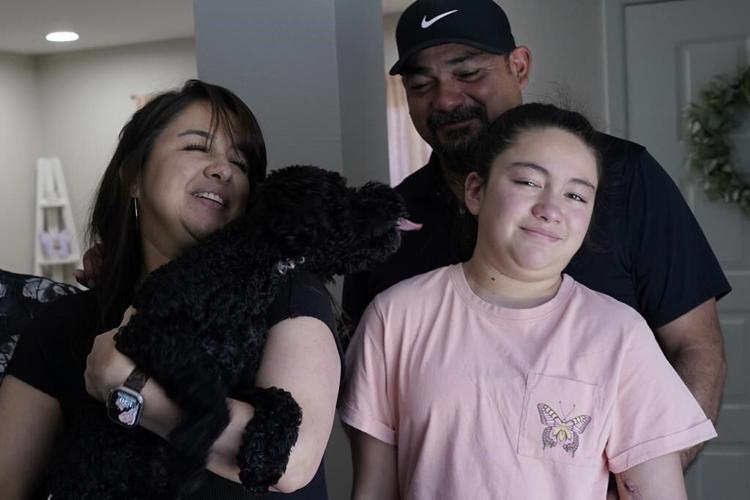
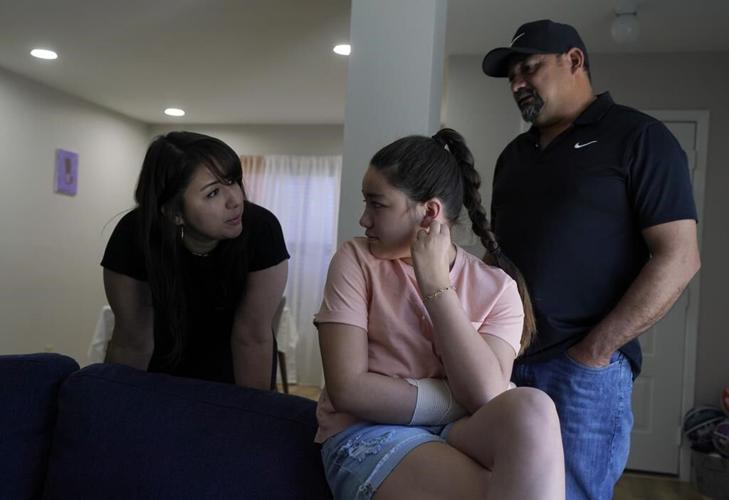
CHICAGO (AP) — More than a year after 11-year-old Mayah Zamora was airlifted out of Uvalde, Texas, where she was critically injured in the Robb Elementary school shooting that killed 19 children and two teachers, the family is still reeling.
Knocks on the door startle Mayah into a panic. The family is skipping Fourth of July celebrations to avoid booming fireworks. An outing to the Little Mermaid movie requires noise-canceling headphones.
Since 2016, thousands of Americans have been wounded in mass shootings, and tens of thousands by gun violence, with that number , according to the . Beyond the colossal medical bills and the weight of trauma and grief, mass shooting survivors and family members contend with scores of other changes that upend their lives.
Survivors talked to The Associated Press about the mental and physical wounds that endure in the aftermath of shootings in Uvalde; Las Vegas; Colorado Springs, Colorado; and the Chicago suburb of Highland Park, Illinois, during a Fourth of July parade last year.
They describe staggering medical bills that in Mayah’s case top $1 million, abandoning a dream career after 20 years, uprooting families and struggling to hold down a job, walk pets or even leave the house.
UVALDE
Mayah suffered wounds to her chest, back, both hands, face and ear, and needed so many surgeries her parents said they stopped counting. The family relocated to San Antonio, where Mayah spent 66 days in the hospital and still needs care.
“Her hospital bill is insane,” said Mayah’s mother, Christina Zamora. “It reaches close to $1,000,000, maybe over,” not including rehabilitation, follow-up visits and counseling.
A year later, Christina and Mayah's father, Ruben, said they don't know what bills will be covered by insurance and how much they will need to pay. When Mayah was discharged, they realized one parent needed to stay home to care for her.
Christina quit her job. Facing daunting bills with one income instead of two is scary, she said. The relocation also has separated the family: Ruben works seven days on, seven off in Uvalde. The couple’s oldest son, Ruben Jr., stayed in Uvalde to attend college and work. Zach, 12, “misses him. He misses our old normal life.”
Mayah is terrified to return to Uvalde.
“It’s heartbreaking when your little one can’t enjoy the things that she did before, and all these other kids are able to do,” the elder Ruben said. “It tears you up.”
COLORADO SPRINGS
Ashtin Gamblin was working the front door at Club Q in Colorado Springs on Nov. 19 when a person armed with a semiautomatic rifle , including Gamblin.
“I was shot nine times. Five to my left arm. Twice to my right arm. Twice to my left breast. Both of my humerus were shattered. So two broken arms,” the 30-year-old said. Six months later, “my right arm is still fractured. My left hand, we’re still working on function.”
Tasks that were once simple, such as walking her dogs, are now challenging and the loss of autonomy has been difficult, Gamblin said.
She has battled with health insurance, the hospital and worker’s compensation officials to figure out who would foot the $300,000 medical bill.
Gamblin also no longer felt safe in her apartment, where she could sometimes hear gunshots outside. She bought a house in a quieter neighborhood: “a house I wasn’t prepared to buy,” she said. “I bought a $380,000 safe space.”
She lists other unexpected post-shooting costs: a flooded basement, a service animal, a new car to get to doctor’s appointments.
Half a year later she is not mentally recovered enough to return to work.
“I just can’t be there… I don’t feel safe going to the grocery store. I don’t feel safe being in public,” she said. “I have no idea what I’m doing with my life currently.”
So far in 2023, nearly 400 people in the U.S. have been wounded in mass shootings, according to the Gun Violence Archive. And 140 people have died in mass killings this year, which is on track to surpass 2019, the deadliest year on record for mass killings since 2006, according to a maintained by The Associated Press and USA Today in a partnership with Northeastern University.
“There is a lot of focus on the people that are killed. And I’m grateful for that. Those are my friends and they deserved all of the attention and more,” Gamblin said. “The downfall is the rest of us are still suffering.”
LAS VEGAS
Tia Christiansen had worked in the music industry for more than 20 years when a gunman at a Las Vegas music festival she helped organize in October 2017.
The shooter rained gunfire from the windows of a high-rise casino hotel into an outdoor concert crowd, killing 58 people and injuring more than 850.
Christiansen was scheduled to be at the festival that day. But she felt ill and stayed in her room, two doors down from where the gunman fired.
“The room was shaking. It was incredibly loud. There was actually a moment when the gunfire was so loud that I literally instinctively ducked and put my hands over my head because I thought that the walls or the ceiling would come crumbling down,” Christiansen said. “I completely reconciled my life and thought, ‘Am I ready to die?’”
She was physically unscathed. But her life turned upside down. After the shooting, she worked a few more festivals, until she “had a complete, total breakdown on site crying.”
“What I came to understand about myself in that moment was, I don’t know if I can do this anymore,” she said.
At concerts, Christiansen no longer focused on fans' joy, instead fixating on emergency exits and whether people could get to safety. She has since given up her career in the music industry, letting go of her dreams.
Her lingering PTSD and need to control her environment also has affected Christiansen’s relationships with her friends and family.
“My personality changes. I get very short tempered, and I get very judgmental. I’m quick to be snippy,” she said. “That is heavy energy to be around.”
Christiansen, who is based in South Deerfield, Massachusetts, turned to spending. She bought a new bed to try to find more comfort and relied on delivered meals to avoid leaving her home.
“The financial aspect of it is crushing, absolutely crushing,” she said. “I don’t know how many years it’s gonna take to pay that off.”
Now Christiansen is part of a mentorship program for the Everytown Survivors Network, which connects thousands of gun violence survivors to resources and aims to end gun violence.
“The trauma doesn’t go away,” she said. “Even if you’re not wounded in the moment, there is injury.”
HIGHLAND PARK
Leah Sundheim, 29, was a night manager at a hotel in Las Vegas when she got “the worst phone call you can ever receive.”
Her mother, Jacquelyn Sundheim, had been killed at a shooting during Highland Park’s 2022 Fourth of July parade, .
“That flight home broke me,” Sundheim said.
She then moved back to Highland Park to be close to her father.
“I couldn’t be away from my family,” Sundheim said. “I can’t do another flight like that ever.”
Mass shootings cause a variety of trauma, she said. Her experience is different from that of her aunt and cousins, who were sitting next to Jacquelyn Sundheim when she died.
“They have the visual and sound… of watching her be murdered, and my dad has the trauma of receiving the phone call and then subsequent hours trying to get to her body. My trauma is waking up to my phone ringing and hearing that my mom was killed,” she said.
Whichever type of trauma survivors experience, she said, “it shatters the sense of security that you have in the world.”
___
Savage is a corps member for the Associated Press/Report for America Statehouse News Initiative. is a nonprofit national service program that places journalists in local newsrooms to report on undercovered issues.