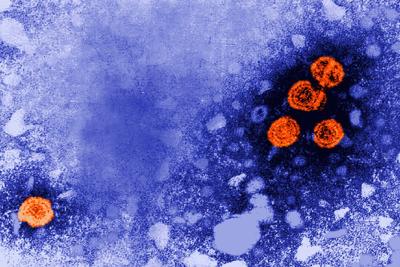
FILE - This 1981 electron microscope image made available by the U.S. Centers for Disease Control and Prevention shows hepatitis B virus particles, indicated in orange. (Dr. Erskine Palmer/CDC via AP, File)
FILE - This 1981 electron microscope image made available by the U.S. Centers for Disease Control and Prevention shows hepatitis B virus particles, indicated in orange. (Dr. Erskine Palmer/CDC via AP, File)
DAKAR, Senegal (AP) — Guinea-Bissau is suspending a Trump administration-backed hepatitis B vaccine study on newborns in the West African country, pending an ethical review, the health minister said Thursday.
A six-person ethics committee didn't meet to review the study during the initial confirmation process, Health Minister Quinhi Nantot said during a news conference held by the Africa Centers for Disease Control and Prevention.
The study is designed as a randomized controlled trial, with some infants given the hepatitis B vaccine at birth and others not. Children will be tracked for death, illness and long-term developmental outcomes. Some experts have suggested that the research plan is unethical, because it will withhold vaccines that work from newborns at significant risk of infection.
Africa CDC Director-General Jean Kaseya said that he fully supports the ethical review and highlighted the agency’s “excellent relationship� with the U.S. government.
“We are led by the interests of our people in Africa," Kaseya said. "We are not led by the small interests of individual people.�
U.S. health officials said Wednesday that the study is still set to proceed.
“The study is proceeding as planned, and we continue to work with our partners to finalize the study’s protocols,� Andrew Nixon, spokesman for the U.S. Department of Health and Human Services, said in a statement.
The Trump administration awarded a $1.6 million, no-bid contract to a Danish university to study hepatitis B vaccinations in newborns in Guinea-Bissau.
The contract was awarded to scientists who have been cited by anti-vaccine activists and whose work has been questioned by leading public health experts.
Research and widespread medical consensus holds that the hepatitis B vaccine protects newborns, so withholding it from some babies has raised ethical alarms.
The U.S. Centers for Disease Control and Prevention awarded the grant to a research team at the University of Southern Denmark that has been lauded by U.S. Health Secretary Robert F. Kennedy Jr. One of the team’s leaders is Christine Stabell Benn, a consultant for a Kennedy-appointed committee that recently voted to a dose of hepatitis B vaccine for all American newborns.
The study was set to begin early this year in Guinea-Bissau, an impoverished West African nation where hepatitis B infection . The researchers are funded for five years to study 14,000 newborns.
Most of the children will be followed for less than two years to look for side effects, but the first 500 enrolled will be followed for five years to look for behavior and brain development problems. As initially designed, there was no placebo involved.
Nixon didn't release any other details about the current version of the study design.
___
Mike Stobbe contributed to this report from New York.