FILE - Microsoft co-founder and former CEO Bill Gates speaks during a 50th Anniversary celebration event at Microsoft headquarters on April 4, 2025, in Redmond, Wash. (AP Photo/Jason Redmond, File)
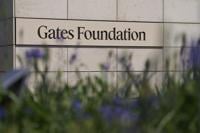
FILE - The Gates Foundation campus sign is seen on April 30, 2025, in Seattle. (AP Photo/Lindsey Wasson, File)
LW
FILE - Microsoft co-founder and former CEO Bill Gates speaks during a 50th Anniversary celebration event at Microsoft headquarters on April 4, 2025, in Redmond, Wash. (AP Photo/Jason Redmond, File)
Innovations on the horizon in women’s health show what’s possible with more investment. With the help of ultrasound equipment powered by artificial intelligence, frontline health care workers may be able to track the progress of developing embryos with a minimum of training. And birth control injections that last six months could give women more control over reproduction.
Those are just two potential breakthroughs out of more than 40 the Gates Foundation intends to support through a five-year, $2.5 billion commitment on women’s health research and development, more than triple the amount it has spent on women’s health innovation over the past five years.
“Many of the most pressing conditions impacting women still remain understudied, underdiagnosed, and overlooked,” said Ru-fong Joanne Cheng, director of Women’s Health Innovations at Gates.
A very small share of medical research funding supports the study of health specific to women, including gynecological and menstrual health, obstetric care, contraceptive innovation, sexually transmitted infections, and maternal health and nutrition, the foundation said. It cited a 2021 McKinsey and Company study that found 1% of all medical research, setting aside cancer research, goes toward women’s health.
The foundation framed the commitment as part of its May announcement that it would and concentrate much of its support on global health. While much of the research funded over the next five years will benefit women worldwide, the foundation said, the need is most acute in sub-Saharan Africa and Southeast Asia.
By devoting billions to women’s health, the foundation has signaled it intends to continue to invest in the cause following the 2024 departure of Melinda French Gates, who led the foundation’s support of girls’ and women’s health. Since her divorce from Bill Gates, French Gates has to improve women’s physical and mental health, provide more economic opportunity to women, and increase their political sway.
The announcement follows a U.S. pullback of support for global maternal health programs during the first seven months of the Trump administration.
The shuttering of the U.S. Agency for International Development and program reductions at the Centers for Disease Control have sunset programs focused on women’s health. According to a the agency’s closure will stop services for 16.8 million pregnant women annually.
In April, the World Health Organization said that the 40 percent decline in maternal deaths from 2000 to 2023 has been put at risk because of aid cuts.
‘We need both innovation and delivery’
While the foundation continues to focus on the delivery of health care globally in an era of governmental retreat, the $2.5 billion will focus squarely on research needed to save lives, Anita Zaidi, president of Gates’s Gender Equality Division, said on a press call Monday to discuss the announcement.
“This is an innovation-focused announcement,” she said. “We need both innovation and delivery.”
It’s important to remember that the U.S. Food and Drug Administration has only been required to test novel drugs on women in clinical trials since 1993, and many tests are still only done on men, said Katy Brodsky Falco, founder of the Foundation for Women’s Health, which plans to make $5 million in research grants this year.
With Gates getting behind research and development of women’s health with such a large commitment, others may follow, Brodsky Falco said.
“Hopefully it will bring the issue to the top of the conversation among private donors and family foundations, even if they otherwise haven’t supported this type of work,” she said.
Moses Obimbo Madadi, professor at the University of Nairobi, noted that postpartum hemorrhaging causes about 3,000 deaths annually in Kenya. If men were the victims, he said, a G7 conference would be called to find a solution, but research on the subject has largely been ignored because it claims the lives of women.
“We’ve treated this as a peripheral issue other than making it a centerpiece of our research,” he said, calling the Gates commitment a “very good starting point.”
_____
Alex Daniels is a senior reporter at the Chronicle of Philanthropy, where you can read the . This article was provided to The Associated Press by the Chronicle of Philanthropy as part of a partnership to cover philanthropy and nonprofits supported by the Lilly Endowment. The Chronicle is solely responsible for the content. For all of AP’s philanthropy coverage, visit .