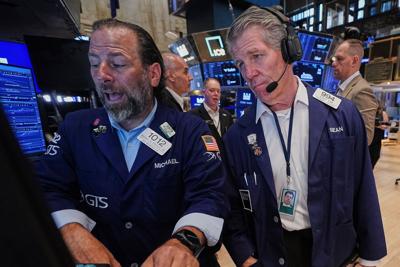
Specialist Michael Pistillo, left, and trader Sean Spain work on the floor of the New York Stock Exchange, Tuesday, June 16, 2026. (AP Photo/Richard Drew)
Specialist Michael Pistillo, left, and trader Sean Spain work on the floor of the New York Stock Exchange, Tuesday, June 16, 2026. (AP Photo/Richard Drew)
NEW YORK (AP) — Stocks wavered to a mixed close on Wall Street as losses for several tech giants including Microsoft weighed on the market. The S&P 500 fell 0.1% on Wednesday, even though more stocks rose than fell within the index. The Dow added 0.4%, and the Nasdaq composite fell 0.4%. Another decline in oil prices helped ease concerns about inflation. Brent crude dropped 3.8%, bringing it closer to where it was before the war with Iran started. Treasury yields fell in the bond market. Google parent Alphabet fell. The company will replace Verizon in the Dow next week.
THIS IS A BREAKING NEWS UPDATE. AP’s earlier story follows below.
NEW YORK (AP) — Stocks wavered in afternoon trading on Wall Street Wednesday as big technology stocks slipped and weighed on the broader market.
The S&P 500 fell 0.3%. The Dow Jones Industrial Average rose 235 points, or 0.5%, as of 3:19 p.m. Eastern. The Nasdaq composite fell 0.8%.
Technology stocks started the day higher, helping to support the market's broader gains amid easing pressure from falling bond yields and lower oil prices. But the influential tech sector is now losing ground for a third consecutive day. Big Tech companies, especially those focused on artificial intelligence, have pricey values that give them more sway over the market’s broader direction.
Nvidia fell 1.2%, following a 4.1% slump on Tuesday. Micron Technology, which reports its latest results later Wednesday, fell 4.1% following its 13.2% plunge on Tuesday. Microsoft fell 1.3%.
Google's parent company Alphabet fell 0.8%. The company is replacing Verizon in the Dow on Monday. The company’s inclusion in the S&P 500 means more to investors, however, because 401(k) accounts are much more likely to include an S&P 500 index fund than anything tied to the Dow.
Alphabet will become the fifth Magnificent 7 company to join the Dow. The others are Apple, Amazon, Microsoft and Nvidia.
Technology companies, especially those with a big focus on artificial intelligence, have been behind Wall Street's record-setting run throughout the year. Analysts have warned, however, that their valuations may have become stretched.
“The next phase of the AI investment cycle is beginning to collide with market discipline," said Jason Vaillancourt, chief portfolio strategist at Columbia Threadneedle, in a research note.
Oil prices continued slipping as the U.S. and Iran negotiate a possible end to their war. Brent crude, the international standard, fell 3.8% to $73.87 a barrel. It has been trading below $80 in recent days but is still above the roughly $70 per barrel it was trading at in late February before the war began. U.S. crude prices fell 3.9% to $70.34 a barrel.
Oil companies had some of the biggest losses. Exxon Mobil fell 2.4% and Chevron lost 2.3%.
Some of the bigger winners on Wall Street included homebuilders following . KB Home surged 16.7% and D.R. Horton jumped 7%.
Treasury yields mostly fell, removing some pressure from stocks. The yield on the 10-year Treasury fell to 4.40% from 4.50% late Tuesday. The yield on the 2-year Treasury eased to 4.14% from 4.16%.
Treasury yields are still elevated from earlier in the year, especially the 2-year Treasury, which more closely tracks anticipated action from the Federal Reserve. The central bank has signaled that it is considering raising its benchmark interest rate by the end of the year. Wall Street is forecasting at least one hike to interest rates by December, according to data from CME Group.
The Fed is worried about stubborn inflation, which had been rising throughout the year as tariffs raised the costs for a wide range of goods. A shock to energy prices because of the U.S. war with Iran worsened inflation. Gasoline prices surged and shipping costs rose. The impact is expected to linger even as oil and gasoline prices fall.
The central bank will get a fresh update on inflation Thursday, when its preferred measure for prices is released. Economists expect the Personal Consumption Expenditures price index, or PCE, to show that prices rose 4.1% in May. That would be the highest level in three years.
“Thursday’s PCE is set to take on greater importance for markets, especially since Federal Reserve Chair (Kevin) Warsh was emphatic in last week’s meeting about the central bank’s desire to achieve price stability,� wrote Rick Gardner, chief investment officer at RGA Investments, in a research note.
Gold prices fell 3.4% to settle at $4,008.80 an ounce. Earlier in the day, it briefly traded below $4,000, and hasn't settled below that level since November. Gold was above $5,000 an ounce earlier in the year. The precious metal is often seen as a barometer of the appetite for risk among investors, with more buying at times of increased anxiety and more selling as anxiety eases.
Markets were mixed in Europe and Asia.
___
AP Business Writers Chan Ho-him and Matt Ott contributed to this report.