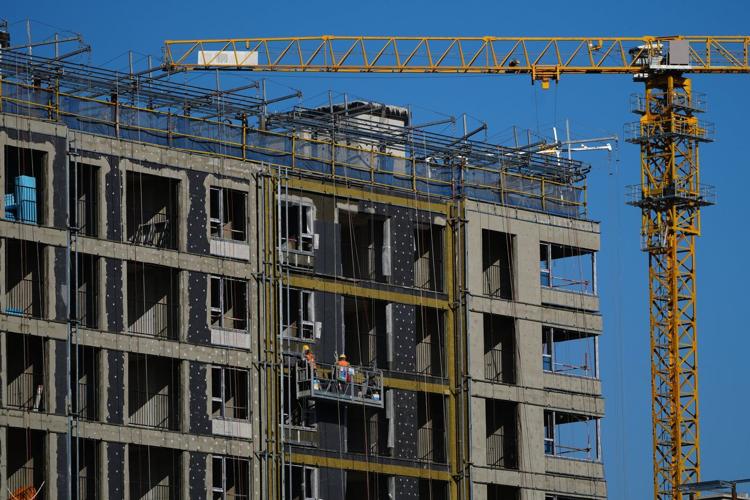
Workers labor on a scaffolding to install insulation layers on a residential building under construction in Beijing on Dec. 3, 2025. (AP Photo/Andy Wong)
Visitors skate across a frozen lake at Shichahai in Beijing, China, Sunday, Jan. 18, 2026. (AP Photo/Vincent Thian)
VT
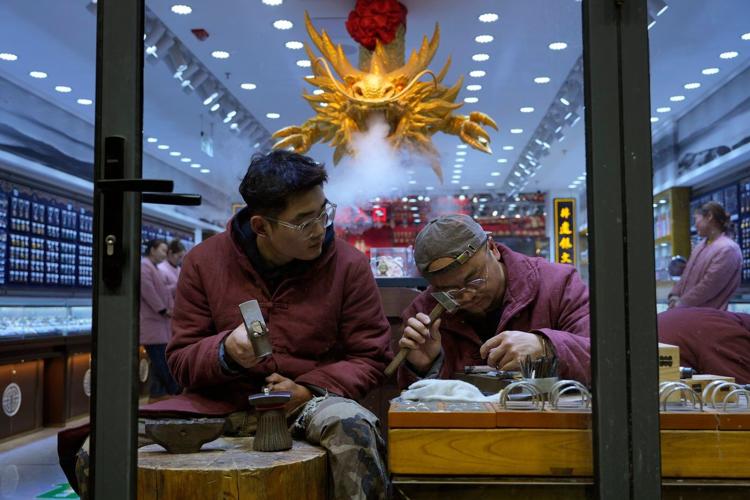
Workers hammer silver jewelry into shape at a shop in Beijing, Thursday, Dec. 18, 2025. (AP Photo/Ng Han Guan)
NHG
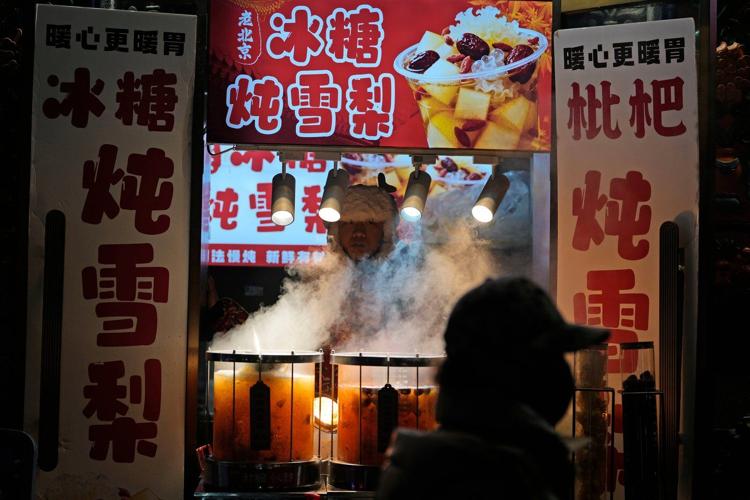
A vendor sells hot drinks in Beijing, Thursday, Dec. 18, 2025. (AP Photo/Ng Han Guan)
NHG
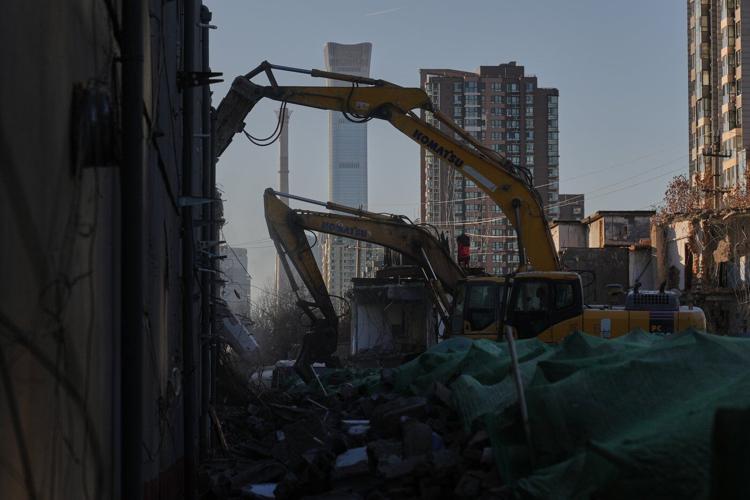
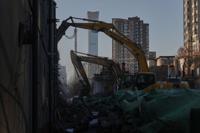
Workers using heavy machineries to demolish an old building near a residential area in Beijing, Tuesday, Dec. 23, 2025. (AP Photo/Andy Wong)
AW
Workers labor on a scaffolding to install insulation layers on a residential building under construction in Beijing on Dec. 3, 2025. (AP Photo/Andy Wong)
HONG KONG (AP) — China's economy expanded at a 5% annual pace in 2025, buoyed by strong exports despite U.S. President Donald Trump's tariffs.
However, growth slowed to a 4.5% rate in the last quarter of the year, the government said Monday. That was the slowest quarterly growth since late 2022 when China was beginning to loosen stringent COVID-19 pandemic restrictions. The economy, the world’s second largest, grew at a in the previous quarter.
leaders have been trying to spur faster growth after a slump in the and disruptions from the pandemic rippled through the economy.
As expected, annual growth last year was in line with the government’s official target for an expansion of
Strong exports helped to compensate for weak consumer spending and business investment, contributing to a record trade surplus of
“The key question is how long this engine of growth can remain the primary driver,� Lynn Song, chief economist for Greater China at Dutch bank ING wrote in a recent note.
Chinese exports to the U.S. suffered after President Donald Trump returned to office early last year and began raising tariffs. But that decline was offset by shipments to the rest of the world. Soaring imports of Chinese goods are leading some other governments to take action to protect local industries, in some cases raising import duties.
“Should more economies also start ramping up tariffs on China, as and the E.U. has threatened to do, eventually, a tighter squeeze will be seen,� said Song.
°ä³ó¾±²Ô²¹â€™s leaders have repeatedly highlighted boosting domestic demand as a policy focus, but their effects have so far been limited. A trade-in program for drivers to replace older cars with more energy-efficient models, for example, in recent months.
“Stabilization, not necessarily recovery, of the domestic property market is key to revive public confidence and, hence household consumption and private investment growth,� said Chi Lo, senior market strategist for Asia Pacific at BNP Paribas Asset Management.
China has also provided trade-in subsidies for home appliances such as refrigerators, washing machines and TVs. While major consumer stimulus policies in 2025 -- including such subsidies -- are set to continue in 2026, they may be scaled back, Weiheng Chen, global investment strategist at J.P. Morgan Private Bank, said in a recent note.
Investments in and other advanced technologies remain a key priority for °ä³ó¾±²Ô²¹â€™s ruling Communist Party as it moves to boost self-reliance and rival the U.S. Meanwhile, many ordinary Chinese and small businesses tough times and troubling uncertainty over jobs and incomes.
Liu Fengyun, a 53-year-old noodle restaurant owner in a small county in southwestern °ä³ó¾±²Ô²¹â€™s Guizhou province, said business has become very difficult these days. Some of her customers told her that “money is hard to earn nowâ€� and “making breakfast at home is cheaper.â€�
“People all say, ‘The overall environment is not good right now — what more can you expect? People don’t have money anymore. Nothing is easy to do now,’� Liu said.
Some economists and analysts believe °ä³ó¾±²Ô²¹â€™s actual economic growth in 2025 was slower than official data suggest. The Rhodium Group, a think tank, said last month it expected °ä³ó¾±²Ô²¹â€™s economy to grow only by 2.5% to 3% last year.
The Chinese economy expanded at a 5% annual rate in 2024, and 5.2% in 2023, according to government data. Ambitious official growth targets have also trended down over the past few years, from to “around 5%� in 2025.
A slower annual expansion is expected for 2026. Deutsche Bank forecasts that °ä³ó¾±²Ô²¹â€™s economy will grow about 4.5% in 2026.
A strong and stable economy is considered crucial for social stability, a primary priority for China's leaders. While China could probably maintain social stability even at lower economic growth rates, Beijing “wants the economy to keep growing�, said Neil Thomas, a fellow at the Asia Society Policy Institute’s Center for China Analysis.
China likely needs to sustain a roughly 4%-5% annual expansion in order to reach its soft target by 2035 of $20,000 gross domestic product (GDP) per capita, he said.