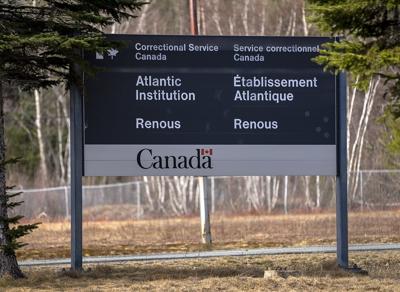
Atlantic Institution is a federal maximum-security facility located in Renous, N.B. seen on Wednesday, April 20, 2022. THE CANADIAN PRESS/Andrew Vaughan
Atlantic Institution is a federal maximum-security facility located in Renous, N.B. seen on Wednesday, April 20, 2022. THE CANADIAN PRESS/Andrew Vaughan
HALIFAX - A lawyer representing a transgender woman incarcerated in a men鈥檚 prison says her client should be transferred to a women鈥檚 institution for her safety.
Lawyer Jessica Rose told a Federal Court judge Monday that male inmates harassed and assaulted her client, Amanda Joy Cooper, after she came out as a woman in 2020. During a virtual hearing, court heard that Cooper, who is now 58, underwent gender-affirming surgery in 2024 and now has the anatomy of a woman.
鈥淪he has experienced 鈥� being groped by another prisoner, taunted, threatened, bullied and being subjected to inappropriate sexual comments from other prisoners,鈥� Rose told Justice Janet Fuhrer.
鈥淎s a result of these encounters, and her reasonable belief that a woman with a vagina is at risk in a maximum-security men's prison, she fears for her physical safety, her sexual safety and her emotional safety.鈥�
Cooper was convicted of multiple sex assaults and declared a dangerous offender in 2001.
In her closing submission, Rose said Cooper was serving time at the maximum-security Atlantic Institution in New Brunswick when she asked to be transferred to a women鈥檚 prison. Instead, Correctional Service of Canada transferred her to Ontario鈥檚 Millhaven Institution, which is also a maximum-security prison for men.
Among other things, the agency cited security concerns for its decision.
During the past two years, Cooper has voluntarily spent virtually all of her time at both institutions in a highly supervised structured intervention unit, which keeps her segregated from the other inmates, Rose told the court.
鈥淭he reason for all of that intensive supervision 鈥� is that segregation causes serious harms to health and well-being,鈥� Rose said, adding that the agency requires prisoners to spend as little time as possible in that unit.
鈥�(But) she doesn't dare risk integrating into the general population at a men's institution because she's a woman with a vagina.鈥�
Court records show that Cooper was convicted of four counts of sexual assault, three counts of assault, and charges of forcible confinement and uttering threats. The documents say all her victims were women, except for one 14-year-old girl.
Rose criticized the agency's decision to keep Cooper in a prison for men because of her long history of victimizing other women. The lawyer said it would be equally absurd to place a male inmate in a women鈥檚 prison because he had victimized other men.
Rose asked Fuhrer to issue a ruling that would order Cooper鈥檚 transfer to a women鈥檚 prison.
Federal lawyer Laura Rhodes told the court that the decision to transfer Cooper to Millhaven was partly based on the agency's requirement to limit her time spent in segregation, adding that Cooper was unwilling to work with her case management team at the New Brunswick prison.
Rhodes said the agency's decision to deny Cooper鈥檚 request for a transfer to a women鈥檚 prison was also based on assessing the risks facing other inmates and prison staff.
鈥淗er requested institutions, the women's institutions, are less restrictive and therefore not suitable for her current risk level,鈥� Rhodes said. 鈥淪he is a designated dangerous offender.鈥�
Cooper applied for a transfer to a women鈥檚 prison in Quebec in 2024, court documents show, but the application was denied because she 鈥渞epresented a very high risk for the inmate population there.鈥�
At the conclusion of Monday鈥檚 hearing, Fuhrer said she would deliver her decision at a later date.
Meanwhile, Cooper has asked another Federal Court judge to grant an injunction in the case, which would allow for her transfer to B.C.鈥檚 Fraser Valley Institute for Women while Fuhrer鈥檚 judicial review works its way through the legal system.
Court documents say there were 125 gender-diverse inmates in the corrections system as of July 2025, comprising about 0.84 per cent of Canada鈥檚 incarcerated population. The documents say 88 were transgender women, with 72 of them housed in men鈥檚 institutions and 16 in women鈥檚 prisons.
This report by 好色tvwas first published June 15, 2026.